

How breathable fishing clothing works and how to care for it
Breathable technical clothing is standard kit for many outdoor activities, and it’s earned its place in fishing too. Whether you’re wearing waders, a wading jacket or waterproofs, modern fabrics keep rain and water out while letting moisture from your body escape. You’ll notice the difference on long days when you alternate between moving around and standing still.
Compared with traditional neoprene waders or basic models made from non-breathable plastics, modern breathable waders give you more freedom of movement and feel more comfortable. Neoprene insulates well, but it’s relatively heavy and lets virtually no moisture escape. Breathable waders are lighter, and by changing what you wear underneath, you can adapt them to temperatures from summer through winter. That makes a difference on cold days in particular. Damp clothing loses some of its insulating ability, so you cool down faster.
BREATHABLE FISHING CLOTHING AT A GLANCE
If you’re choosing breathable waders or a wading jacket, or want to get more out of the gear you already own, this guide explains how the membrane works, how to read the specs and what to keep in mind when wearing and caring for your gear.
- Membrane. It keeps liquid water out while allowing water vapour to escape.
- Technical specs. Hydrostatic head tells you how much water pressure a material can withstand. A lower RET value means water vapour passes through the material more easily.
- Dampness inside your waders. If your waders feel clammy after a day on the water, condensation could be the cause.
- Layering and ventilation. A breathable base layer and suitable midlayers help move moisture away from your skin. Vent before you get too hot to cut down on sweating.
- Care. Clean your waders and wading jacket as directed by the manufacturer, dry them completely before storing them and renew the water-repellent treatment as needed.
CONTENTS:
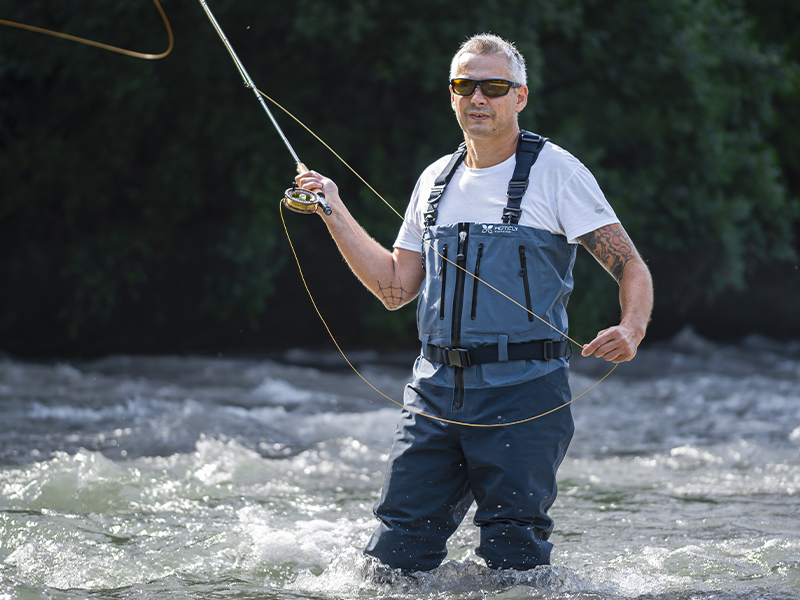
Modern wading gear can keep you dry while allowing water vapour to escape.
1. HOW DOES BREATHABILITY WORK?
Waterproof and breathable might sound like a contradiction. The two properties are possible thanks to a thin membrane at the heart of modern technical clothing. It blocks liquid water while allowing water vapour to pass through. Manufacturers mainly use two types of membrane.
Microporous membranes contain countless tiny pores. These are large enough for water vapour to pass through but small enough to keep liquid water droplets out. GORE-TEX is a familiar example of this technology.
Hydrophilic membranes, also called monolithic membranes, have no pores. They absorb moisture on the inside and transport individual water molecules through the material. The moisture is then released to the surrounding air.
Both types are designed to keep water out while moving moisture from perspiration to the outside. The membrane is bonded to other layers to form a laminate, often with three, four or five layers. The construction affects properties such as weight, durability and abrasion resistance.
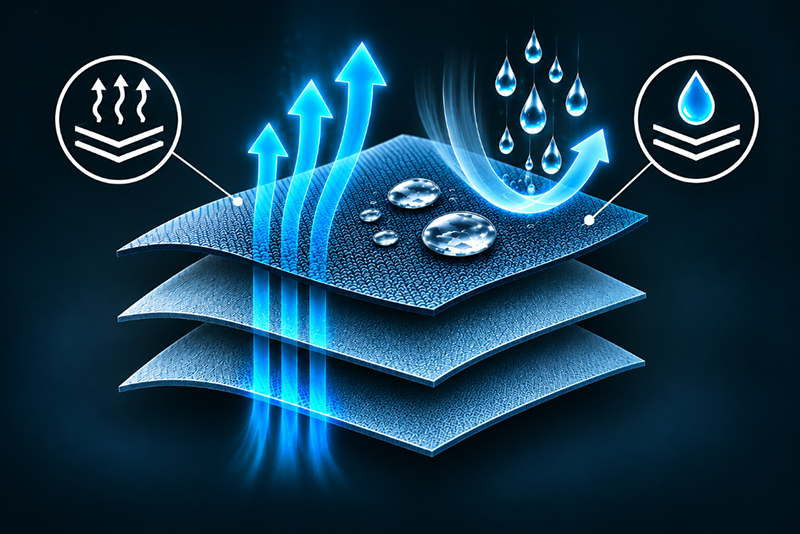
Specialised membranes keep water droplets out while allowing water vapour to escape.
2. WHAT DO THE TECHNICAL SPECS MEAN?
Product descriptions and labels for waders and jackets often list figures such as a hydrostatic head of 20,000 mm or a breathability rating of 10,000 g/m²/24 h. What do those numbers actually tell you?
Hydrostatic head measures how much water pressure a material can withstand. A sample is placed in a testing device and subjected to steadily increasing water pressure. The rating in millimetres represents the height of a column of water that would exert that pressure before water penetrates the fabric. A rating of 20,000 mm corresponds to the pressure exerted by a 20-metre column of water. A higher value means greater resistance to water penetration. ISO 811 is one international standard used for this test.
Breathability is often expressed in grams per square metre per 24 hours. A rating of 10,000 g/m²/24 h means that, under the test conditions, the equivalent of ten kilograms of water vapour can pass through one square metre of material in 24 hours.
Different test methods are used, so the figures aren’t always directly comparable. Another measure is the RET value, which describes a material’s resistance to water vapour passing through it. The lower the value, the more easily moisture can escape.
These figures help you compare how materials perform in a test. Comfort in waders or a jacket on the water also depends on the conditions and what you’re doing.
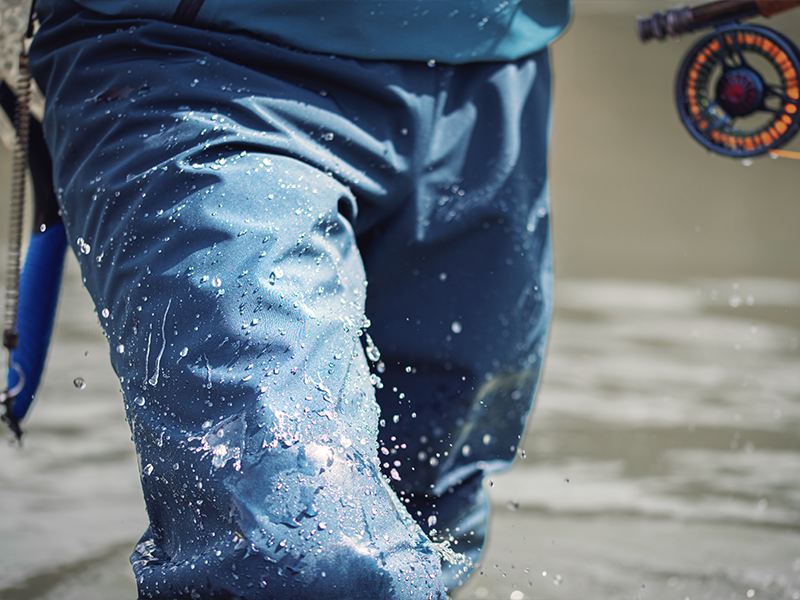
Breathable waders keep water out during long spells of wading.
3. WHY DO MY WADERS STILL FEEL DAMP INSIDE?
You’ve bought a new pair of quality breathable waders, and on your first few fishing trips the inside starts to feel damp after a while. Are your waders leaking? Is there something wrong with the membrane?
Even waders in perfect condition can get damp inside. The best technical fabrics are still subject to the laws of physics.
Your body constantly releases moisture. Some of it enters the surrounding air as water vapour through your skin and breath. For water vapour to move out through the membrane, its partial pressure has to be higher inside than outside. This difference drives the transfer of moisture. In general, the greater the difference, the more readily water vapour can move through the membrane.
Temperature and the amount of water vapour in the air on either side of the fabric play a big part. Wind can also help by carrying moist air away from the outside of the garment.
In cold weather, the temperature may vary considerably between the layers you’re wearing. When warm, moist air meets a surface colder than its dew point, some of the water vapour turns into liquid. This is condensation, and it can leave moisture on the inside of your waders even when they’re watertight.
Think of the droplets you see on a cold window on a damp winter day. The same thing can happen between layers of clothing. Condensation can build up inside even though the membrane is intact and waterproof.
Liquid water can’t pass through the membrane in the same way as water vapour. In microporous membranes, it can interfere with the way the pores work. Moisture and temperature affect vapour transfer differently in other types of membrane. A saturated outer fabric can also reduce breathability considerably.
The result is a damp, clammy feeling inside your waders, which can come from condensation. Even good technical clothing has its limits, especially when it’s cold and you’re working hard.
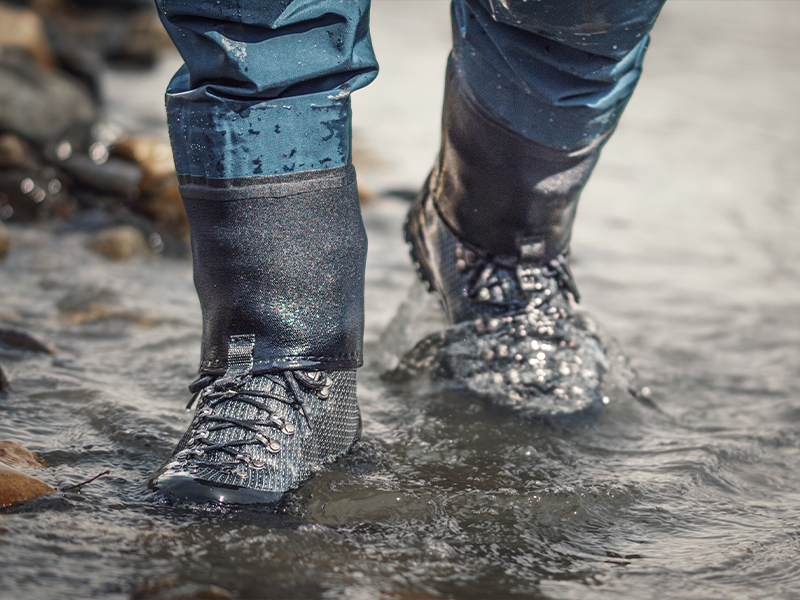
The neoprene booties built into your waders are waterproof and trap moisture, so condensation can build up more easily around your feet.
4. HOW DO I GET THE MOST OUT OF BREATHABLE FISHING CLOTHING?
The quality of the membrane matters, and so do the layers underneath and the adjustments you make throughout the day.
Choose the right layers. Layering works well for fishing. Each layer should help move moisture outwards. Wear a breathable base layer and suitable midlayers to draw sweat away from your skin. Cotton absorbs moisture and holds on to it, making it a poor choice here. When you buy waders, check the size and fit so you can still move freely with a warm layer underneath.
Avoid overdressing. If you’re too warm before your first cast, you’ll soon start to sweat. That moisture then has to travel through every layer you’re wearing. Start with fewer layers and add something warm when you need it, such as a breathable fleece.
Vent before you overheat. Fishing often means switching between walking and standing still. If you’re walking to a distant spot in the sun, unzip your jacket early to let excess heat out. If you then spend a while fishing in one place, zip it back up before you get cold. It’s easier to stay comfortable if you make those adjustments before you’re already sweating heavily or shivering.
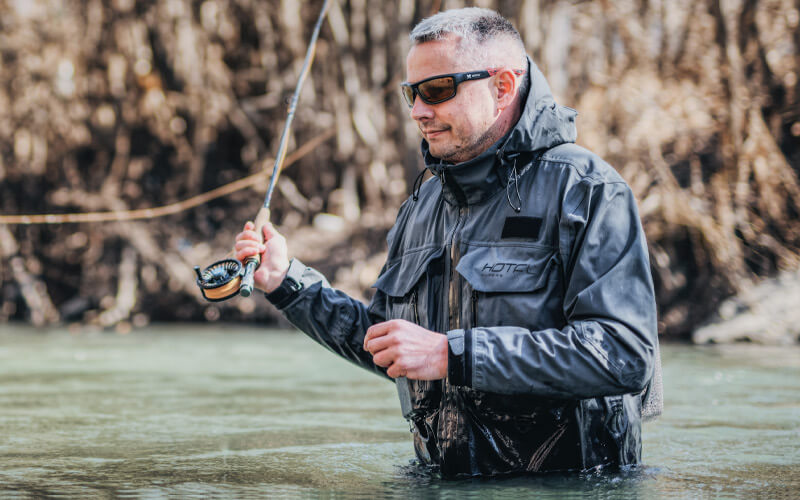
Unzip your wading jacket before too much heat builds up inside.
5. PROPER CARE KEEPS YOUR GEAR PERFORMING
Even the best waders and jackets need regular care to stay breathable. Dirt, dust, body oils and other residues can affect how the fabric performs. Build-up on microporous membranes in particular can interfere with moisture transfer through their fine pores.
Remove any mud and loose dirt after fishing. When your gear needs a more thorough clean, use a suitable technical wash. Skip fabric softener and harsh cleaners, which can damage the membrane or the water-repellent finish on the outer fabric. Follow the manufacturer’s care instructions for the wash cycle and temperature.
Let your gear dry completely after every use, then put it away. Leaving damp clothing in a bag or cupboard for long periods encourages mould and can permanently damage the material. Dry waders and jackets in a well-ventilated place and store them clean and completely dry.
The outer fabric also has a water-repellent finish known as DWR, short for durable water repellent. It makes droplets bead up and roll off instead of soaking into the fabric.
Abrasion, dirt and regular use gradually wear this finish down. When the outer fabric starts to soak up water, it can feel cold and heavy and make it harder for moisture to escape, even if the membrane is still waterproof. Restore the DWR as needed with a suitable spray-on or wash-in treatment. Follow the manufacturer’s instructions, since different materials need different treatments.
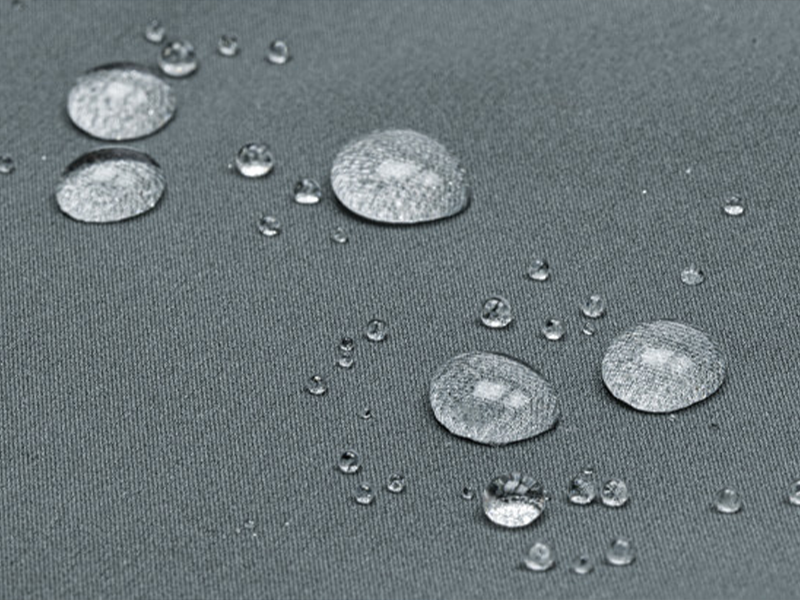
A durable water-repellent finish helps prevent the outer fabric from soaking through, so water vapour can escape more easily.
Modern breathable fishing clothing offers excellent protection and comfort. The right layers, a few adjustments on the water and regular care help keep it performing well over time.
Enjoy your time on the water, whatever the weather or season!
6. FREQUENTLY ASKED QUESTIONS ABOUT BREATHABLE FISHING CLOTHING
The membrane keeps liquid water out while allowing water vapour to escape. How well it breathes on the water depends in part on temperature and humidity.
Microporous membranes let vapour through tiny pores, while pore-free membranes move water molecules through the material. When choosing waders, also consider the weight and abrasion resistance of the complete laminate.
In a lab test, the material withstands the pressure exerted by a 20-metre column of water. The higher the rating, the more water pressure the material can withstand under the test conditions.
Under the test conditions, the equivalent of ten kilograms of water vapour can pass through one square metre of fabric in 24 hours. How much moisture actually escapes during use depends in part on temperature and humidity.
RET measures how much a material resists the passage of water vapour. The lower the value, the more easily vapour passes through.
The most meaningful comparison is between figures obtained using the same test method. This holds even when both brands quote their ratings in g/m²/24 h.
Even watertight waders can feel damp when warm, humid air condenses against the colder inner surface. This can happen particularly easily when you wade in cold water.
Yes. A breathable base layer and a warm midlayer let you dress for the cold. Neoprene waders provide more of that insulation through the material itself.
Synthetic base layers help move sweat away from your skin, and fleece makes a warm midlayer on cold days. Cotton holds moisture and can quickly feel clammy.
Wear fewer layers on the walk in and unzip your wading jacket as soon as you start to feel too warm. When you settle into a spot, zip it up again or put on a warm layer.
For a more thorough clean, use a suitable technical wash and follow the manufacturer’s instructions for the wash cycle and temperature. Avoid fabric softener and harsh cleaners.
Hang them somewhere well ventilated and make sure the inside dries as well. Put them in a bag or cupboard only once they’re completely dry.
If water stops beading and starts soaking into the outer fabric, the finish has lost some of its effectiveness. If that still happens after washing, renew the treatment as directed by the manufacturer.
Yes. The membrane can still keep water out when the outer fabric is saturated. The soaked fabric can feel cold and heavy and make it harder for vapour to escape.

This might also interest you:

Gear Test: JMC KULT TLT 7'6" #3/4
The JMC KULT TLT 7'6" #3/4 is designed for the distinctive demands of Italian casting. We examine its measured power, fast action, build and balance before turning to SIM Suisse instructor Jean-Pierre Panizzi's detailed on-water assessment with DT3 and DT4 lines. His findings reveal where this short fly rod excels – and the precision it demands from the caster.

10' Fly Rod Showdown: JMC KULT vs Marryat WISDOM
Four 10' fly rods, two matching line ratings and some revealing differences. This comparison puts the JMC KULT and Marryat WISDOM in #3/4 and #4/5 under the microscope, examining their measured power, action, components and balance. From delicate dry-fly presentations to switching between dries and Euro nymphing, we explore where each model fits—and why a 10' rod still deserves a place on the river.
Gear Test: JMC KULT TLT 7'6" #3/4
The JMC KULT TLT 7'6" #3/4 is designed for the distinctive demands of Italian casting. We examine its measured power, fast action, build and balance before turning to SIM Suisse instructor Jean-Pierre Panizzi's detailed on-water assessment with DT3 and DT4 lines. His findings reveal where this short fly rod excels – and the precision it demands from the caster.
10' Fly Rod Showdown: JMC KULT vs Marryat WISDOM
Four 10' fly rods, two matching line ratings and some revealing differences. This comparison puts the JMC KULT and Marryat WISDOM in #3/4 and #4/5 under the microscope, examining their measured power, action, components and balance. From delicate dry-fly presentations to switching between dries and Euro nymphing, we explore where each model fits—and why a 10' rod still deserves a place on the river.

Gear Test: Soldarini Daytona #1/4 & #2/5
A longer trigger lever, a carbon disc drag and a quick-release spool: the Soldarini Daytona brings several thoughtful features to the semi-automatic fly reel. This review examines both sizes, #1/4 and #2/5, with a particular focus on line capacity, rod balance and easy trigger access when fishing long Euro nymphing rods.

Gear Test: Vision Nymphmaniac Twintip 9'9 #3, 10'3 #3 & 10'3 #4
This test of the Vision Nymphmaniac Twintip range focuses on the shorter models: the 9'9 #3, 10'3 #3 and 10'3 #4. Based on Common Cents System measurements, the comparison examines power, action, balance, guide layout and intended fishing applications. From dedicated dry-fly fishing to refined Euro nymphing and versatile all-round use, each model offers a distinct approach for trout anglers fishing small and medium-sized rivers.

9' #5 fly rod showdown €250
Two modern Scandinavian fly rods, one identical mission: delivering maximum performance in the highly competitive sub-€250 segment. In this in-depth comparison, we take a closer look at the Guideline Rivolt and the Vision Hero² in 9' #5 — analysing their true power, action, build quality and overall fishing comfort to find out where each rod truly shines on the water.

Gear Test: Guideline Elevation 10' #6 & 10' #7
The Guideline Elevation series has earned an excellent reputation among competition anglers and reservoir specialists alike. In this review, we take a closer look at the Elevation 10' #6 and 10' #7, analysing their power, action, balance and intended applications through Common Cents System measurements.

Gear Test: JMC YOTO XPR 30 & 50
More than a decade after the launch of the original YOTO, JMC has updated its iconic semi-automatic fly reel. In this review, we take a closer look at the new YOTO XPR 30 and 50, analyse their technical improvements and examine where each model excels for Euro nymphing, dry-fly fishing and versatile trout fishing applications.

Gear Test: Vision RIVER HERO vs. NYMPHING HERO²
With the launch of the new Hero² series, Vision updates one of the most popular value-for-money fly rod ranges on the market. In this review, we take a closer look at the River Hero 9'3 #3 and the Nymphing Hero² 10'6 #3, analysing their power, action, component configuration and practical applications through Common Cents System measurements and extensive on-the-water experience.

Gear Test: JMC PURE NGX 11' #2
A detailed review of the JMC PURE NGX 11' #2 fly rod. We analyse its true power and action using the Common Cents System and take a closer look at its balance, build quality and suitability for modern tight line nymphing. The article also features impressions from two-time individual World Fly Fishing Champion Julien Daguillanes, who relied on this rod throughout his 2025 competition season.

Gear Test: Vision Nymphmaniac Twintip 10'9 #2 / #3 / #4
This test of the Vision Nymphmaniac Twintip series highlights the specific characteristics of the 10'9 #2, #3 and #4 models. Based on Common Cents System measurements, the comparison analyses power, action, balance, build quality and intended fishing applications. From delicate Euro nymphing setups to more powerful approaches for larger trout, this test shows which model best matches your fishing style.

Gear Test: JMC PERFORMER 2.0 10'6" #2/3
A detailed test of the JMC Performer 2.0 10'6" #2/3 fly rod, focusing on Euro nymphing applications. Power and action are analysed using the Common Cents System, alongside build quality, balance and real fishing performance. This review provides clear insights for anglers looking for a precise and competition-oriented nymph rod for small to medium rivers.

Gear Test: JMC FURIOUS LEGACY SERIES
A detailed analysis of the JMC Furious Legacy predator fly rods, covering power, action, build quality and fishing performance. Based on objective CCS measurements and practical on-water impressions, this review provides clear guidance for choosing the right rod for pike, catfish and other predator species.

Gear Test: JMC PURE NGX 8'6 #5 / 9' #5 / 10' #4
A detailed comparative test of the JMC Pure NGX fly rods in 8'6 #5, 9' #5 and 10' #4. Power, action, build quality and on-water performance analysed using the Common Cents System, with practical insights for choosing the right model.

Gear Test: JMC KULT 10'6 #2/3 / 11' #1/2 / 11' #3/4
This in-depth comparison of the Euro-nymph-models of the JMC KULT series focuses on what truly matters on the water: power, action, balance and overall fishing feel. Based on Common Cents System data and practical experience, it gives you a clear understanding of how each rod performs—and which one makes the most sense for your style of Euro nymphing.

Gear Test: Guideline Experience Chest Pack
With the Experience Chest Pack, Guideline expands its popular Experience range with a compact and versatile chest pack for fly anglers. Whether attached to your waders, worn on a belt or carried around the neck, this minimalist pack impresses with thoughtful storage, low weight and flexible carrying options for quick and spontaneous sessions on the water.

Gear Test: HOTFLY FLYMASTER vs VISION ONKII
Two modern 9' #5 fly rods, two different personalities, one shared goal: delivering versatile trout performance without breaking the bank. In this in-depth comparison, we put the Hotfly LITECRAFT FLYMASTER V3 and the Vision ONKII side by side, analysing their CCS measurements, action profiles, build quality and on-the-water behaviour to better understand where each rod truly shines.

Long-Term Test: Hotfly Essential Waders
How much wader do you really need? The Hotfly Essential focuses on the essentials—without compromising on materials or construction. We tested this model over an entire season and show you how it performs in terms of durability, comfort, and value for money.

FISHING ITINERARIES - Discovering the Scottish rivers with our friend Erik
A nice test by our friend Erik, who brought around the rivers all over Europe Andrew wading boot - Hotfly waders Alpine Diver V2. Big brown trout and beautiful graylings were not missed!!!!

First steps in andrew wading boots
Fly fishermen are generally true enthusiasts and extremely attentive to the quality of their equipment. Remarkable progress has been made in recent years. The carbon of fly rods combines lightness and

Our MADE IN ITALY flies - a look behind the scenes
Come with us to Piedmont and see where our MADE IN ITALY flies come from and who ties them. Find out all about the catchy flies and get to know Morgan and his team at Il Sayot.

Guideline's new products for 2024
How a presentation of Guideline's new products for 2024 turned into a spontaneous casting course with Chris Rownes and what fly casting has to do with breathing.

Flies from the 3D printer
Printed flies? Yes, it works, very well in fact. The silicone replicas not only look extremely realistic but are also super-catchy. Take a look behind the scenes with us and find out how they are made.

Looking for revolutionary wading boots that are almost indestructible?
Are you tired of buying wading boots that fall apart after a few fishing trips, in which the soles detach after half a season or with seams that brake after a brief time? Then we are ...

FLOATANT - Discover the complete guide to all Loon Outdoors floatants
Often the wide variety of floatants made available by LOON OUTDOORS can generate some doubts, especially among less experienced fly fishermen. With this mini-guide we would like to make...


