

CONTENTS:
- Where can I go fly fishing in South Tyrol?
- What else do you need in order to fish in South Tyrol?
- Our water recommendations for you
- On the water with a guide – why it is worth it
- What gear makes sense for fly fishing in South Tyrol?
- Which flies work especially well in South Tyrol?
- FAQs
A fishing destination set in a remarkable alpine landscape
Between the vineyards in the south and the snow-capped peaks of the Dolomites lies a landscape of rare variety, rising from less than 200 m above sea level to almost 4,000 m. This particular mix of alpine terrain and Mediterranean influence makes the region more than a well-loved travel destination. It is also a compelling place for anyone looking to experience fly fishing in South Tyrol.
Few regions place so many different kinds of water within such easy reach. Broad valley rivers such as the Adige, Isarco, Rienza and Passirio cut through the main valleys, while clear mountain streams, remote high-alpine lakes and a number of productive reservoirs draw anglers into higher country. Depending on elevation and type of water, the fishing season can begin as early as February and often runs through to the end of November – a generous window with plenty of room for memorable days on the water.
It is no surprise, then, that we regularly hear from passionate fly fishers from all over the world asking the same practical questions: Where is the best fly fishing in South Tyrol? Which waters are especially worth fishing? And where can visiting anglers get permits? This article is meant to give you clear, useful answers – structured, practical and designed to make planning your own fly-fishing trip to South Tyrol as straightforward as possible. Whether you are organizing your holiday well in advance or simply packing a rod on short notice, you will find the key information here in one place.

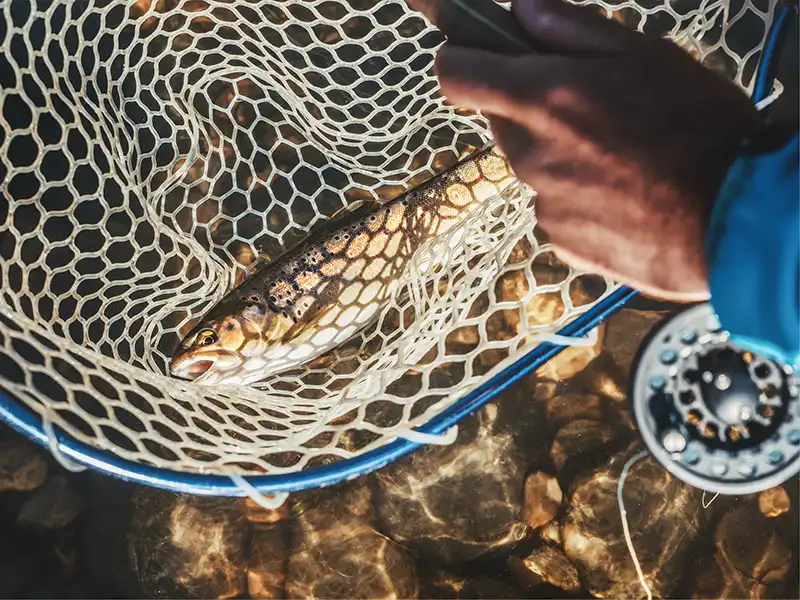
Marble trout from the Isarco – taken on a Pheasant Tail nymph
The waters of South Tyrol are shaped by their alpine setting and are home primarily to salmonids. In the larger rivers, marble trout and grayling are the defining species, while the cooler mountain streams are classic brown trout water. Char, meanwhile, find ideal conditions in the clear lakes of the high country. The story of the marble trout is especially interesting: yes, they are still here – and yes, in the larger valley rivers your chances of connecting with a marmorata on the fly are not bad at all. For roughly a decade, South Tyrolean fisheries have been working intensively through the Marmogen project to rebuild and secure genetically intact marmorata stocks for the long term. For that reason, marble trout are protected year-round: they may be fished for, but not harvested.

Adriatic grayling – still present in the waters of South Tyrol
The situation is similar with grayling. The catchment of the Adige and its tributaries is home to the so-called Adriatic grayling – a genetically valuable population. To protect it, harvest is limited to a maximum of one grayling per fishing outing, although many fishery managers apply even stricter rules on their own waters.
Good to know: In South Tyrol, anglers generally have the freedom to decide responsibly whether to keep or release fish that meet the legal size limit and are not protected. Undersized fish and protected species, of course, may not be harvested under any circumstances. Catch and release is therefore not prohibited by law in South Tyrol. For many visiting anglers, the real point of the day is the experience of being out in the landscape, not reaching a limit. We therefore recommend fishing with barbless flies wherever they are not already mandatory. It makes fish handling cleaner and more enjoyable, and it also helps protect the remarkable fish populations that make these waters so special.
In this article, we focus exclusively on fly fishing for salmonids in South Tyrol. You will learn which waters are especially rewarding, which rules apply and how to get the permits you need without unnecessary complications – so that nothing stands in the way of your own South Tyrolean fishing experience. Please note: the waters recommended here have been selected to the best of our knowledge, with a focus on sections where fly fishing only is permitted. The selection reflects our personal assessment and does not claim to be complete – South Tyrol has many other outstanding waters waiting to be explored. Some of the fisheries where artificial lures are allowed alongside the fly also include very interesting stretches for fly anglers. The information on the waters presented here reflects the situation at the time this article was last revised. Because fishing regulations, access options and management responsibilities can change at any time, we also provide the website of the relevant fishery manager or association wherever possible. This allows you to check the latest rules directly and reliably when needed.
1. Where can I go fly fishing in South Tyrol?
Fishing in South Tyrol is strongly shaped by the system of private fishing rights. Around 92% of the fishing rights on public fishing waters are privately held – meaning that the right to fish a particular stretch belongs either to private individuals or to fishing associations. Only those who own this right, or have leased it, are allowed to fish there. Alongside dedicated private owners, the waters are managed above all by numerous local fishing clubs, many of which carefully maintain and look after their sections of river. The remaining roughly 8% of fishing rights belong to the public authorities. These sections are usually granted for fixed periods as concessions to clubs or other organizations, which are then responsible for managing them.
Whether you, as a visiting angler, are allowed to fish a specific water therefore always depends on the respective holder of the fishing rights. They decide whether, and to what extent, day permits or guest permits are issued. While many clubs are very welcoming to visiting anglers and actively make their waters accessible, others reserve their fisheries exclusively for members.

SüdtirolFishing - the digital solution for your fishing permits in South Tyrol
A major step forward for visiting anglers is the recent largely digitalized issuing of fishing permits in South Tyrol. With the official South Tyrol Fishing app, there is now, for the first time, a central platform that allows you to take care of all the key steps around fishing conveniently online. You can register in just a few minutes before your trip and then use the app to get an overview of the available waters. The integrated map function shows all fisheries where guest permits are available, making it much easier to plan your days on the water. Buying the actual permit is just as straightforward: select the water, choose the date and purchase the right day permit directly on your smartphone – quickly, securely and without unnecessary detours.
That means the often time-consuming search for permit outlets is largely a thing of the past. You can move around with far more flexibility – whether you are planning a fishing holiday well in advance or deciding spontaneously to spend a few hours on a new stretch of water. The app also keeps the most important information close at hand at all times: closed seasons, regulations, permitted methods, and even your fishing outings and catches can be managed directly there. Worth noting: although digital access is now the main route, a limited number of paper day permits are still available on certain sections for anglers travelling without a smartphone. The respective fishery manager can tell you exactly where this applies.


2. What else do you need in order to fish in South Tyrol?
To fly fish the waters of South Tyrol, you need more than a day permit. One further document is essential: the Italian state fishing license type D. This license is valid throughout Italy and serves as your official “fishing passport” for every region of the country – not only South Tyrol.
The good news: getting the license is straightforward and requires very little effort. The fishing license type D is issued by the Provincial Office for Hunting and Fishing and is valid for a full 10 years. To apply, you only need:
- two revenue stamps of 16 € each (available at any tobacconist),
- two passport photos,
- the relevant application form, which can be downloaded online.
If you are coming to South Tyrol as a visiting angler, you usually do not have to deal with the paperwork on your own. In many cases, the local tourist offices or even your accommodation can help, especially if they are used to hosting fly-fishing guests. The fly-fishing guides introduced further below will also be happy to assist in arranging the necessary guest license quickly. With that taken care of, nothing stands between you and your time on the water.
Further information and the application form for the fishing license type D can be found here: Information on the Italian state fishing license type D .
3. Our water recommendations for you
Anyone travelling through South Tyrol with a fly rod is faced with a fine problem: there is almost too much to choose from. Between valley rivers, rugged gorges, clear mountain streams and alpine lakes, the region offers an impressive range of waters that lend themselves beautifully to the fly. To make orientation a little easier, we have put together a selection of especially rewarding fly-fishing stretches – waters we know well ourselves and have fished several times.

This overview is intended as a personal recommendation, not as a complete directory. For the following list, we have selected ten fly-fishing stretches on both larger and smaller rivers and streams, giving a good impression of South Tyrol’s range and character. Wherever you spend your next holiday in the region, you should find a worthwhile water recommendation within reach. The stretches are presented from west to east to make orientation simple. The order is not a ranking and says nothing about whether one section is better or less interesting than another – each of these waters has its own character and its own moments to offer. And it is important to say this clearly: South Tyrol has far more appealing waters capable of delivering outstanding days than the selection below. Many lesser-known stretches that do not yet appear on our list have a quiet appeal of their own and are still waiting to be discovered.
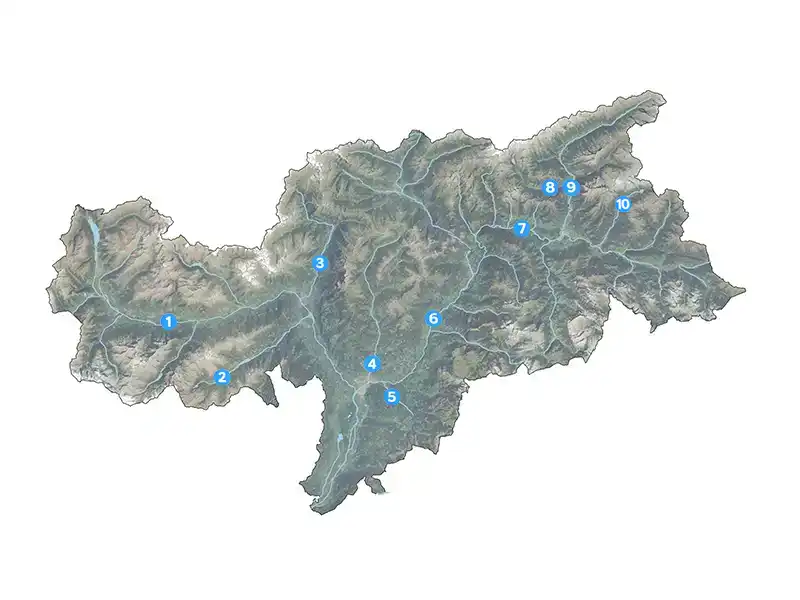
Spread across the entire region - 1. Adige, 2. Valsura, 3. Passirio, 4. Talvera, 5. Rio Ega, 6. Little Isarco, 7. Rienza, 8. Rio di Selva dei Molini, 9. Aurino, 10. Rio Anterselva
All information reflects the situation at the time this article was last revised. Because regulations, prices and management responsibilities can change, we link – wherever possible – directly to the website of the relevant fishery manager or association. This allows you to check the latest rules quickly and reliably whenever needed.
3.1. The Adige between Covelano and Laces
The Adige rises at Passo Resia and is the second-longest river in Italy. Between the powerful peaks of the Ortles group and the sun-warmed slopes of the Monte Sole in Val Venosta, it runs for many kilometres through one of South Tyrol’s most striking inner-alpine valleys. If you have the chance to fish here, we can recommend the roughly 8.5-kilometre fly-fishing stretch from the Covelano bridge to the Laces bridge – a varied section with plenty to offer anyone who enjoys classic fly fishing.
In the middle Val Venosta, the Adige already has the feel of a medium-sized river, yet it can still be fished well and effectively with the fly. Although parts of it have been straightened, there are still morphologically and therefore angling-wise interesting sections where the river shows real variety: gravel bars, broad runs, deep scoured pools and shifting currents. Depending on water level and season, this well-supplied residual-flow stretch can run calm and clear, or move with real pace and carry the glacial colour of the Ortles massif – conditions that call for touch, adjustment and a good eye for current and structure.
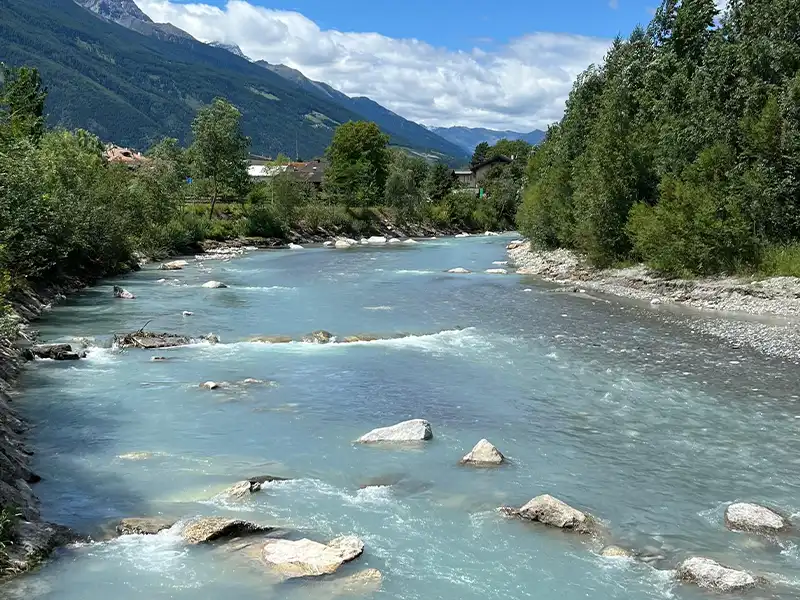
A beautifully structured section of the Adige near Laces
From a fishing perspective, the Adige around Covelano and Laces is now one of the most interesting sections of the river in Val Venosta. For years, the fish population has been managed through a consistently sustainable approach, with a strong focus on protecting and preserving the marble trout. A great deal of commitment and stocking material was needed after a disaster in the summer of 2018, when a devastating mudslide from Val di Lasa almost completely wiped out the fish population across long stretches of the Adige. In response, the Angling Association of Merano took an exceptional step: for around three years, it completely suspended fishing, stopped selling day permits and also refrained from stocking harvestable rainbow trout. Instead, the focus shifted entirely to the regeneration of the water and the natural rebuilding of the population. During this period, large areas of the stretch received genetically certified egg and fry material from marble trout, carefully introduced into suitable sections to support stable wild stocks.
That patience and foresight paid off. As early as 2022, the first spawning adult fish from the affected section were documented, and monitoring surveys showed encouraging numbers of young marble trout. Current assessments indicate that around 60% of the entire trout population now consists of genetically intact marble trout. These figures show that the careful management strategy and the consistent use of stocking material derived from wild fish are working. For the fly angler, this means a rare opportunity to catch a true marmorata – a special experience, and without question one of the fishing highlights South Tyrol has to offer.
The stretch also holds brown trout and rainbow trout, both of which thrive here. A few grayling are present as well, but like the marmorata they are protected year-round and may not be harvested. The varied structure of this section, with deep glides, gravel shallows and plenty of boulders breaking the flow, creates excellent habitat for all salmonids. The Adige here is not an easy river, but it is an honest one – read it carefully, and it can reward you well.
Fishing is permitted only with a fly rod, fly reel and fly line. Artificial barbless flies are allowed – no more than two at the same time. Jigs, streamers and any form of weight on the leader are prohibited. From 1 October, fishing is limited to dry and wet flies in order to protect spawning fish. In October, anglers should generally avoid wading so as not to disturb sensitive spawning areas. A maximum of four salmonids may be harvested per day, excluding marble trout and grayling, with only one brown trout permitted. All current information and further details can be found on the official website of the association at www.fischereiverein-meran.it.
The fishing season runs from the second Sunday in February to 31 October. Spring can be especially good, when the water is still clear and the first signs of snowmelt are only beginning to show. Autumn, too, can bring the Adige into fine form: cooler nights, reduced sediment load, calmer flows and water full of life. That is when the river’s particular appeal comes through – delicate nymphing in deep runs, carefully placed dry flies in slower back eddies, and classic wet-fly fishing through the seams and transitional water.

Excellent conditions in spring and autumn, with clear water and reduced flow
Access to the stretch is excellent along its entire length. The Val Venosta cycle path runs – apart from a few short interruptions – directly alongside the Adige, sometimes on the left bank, sometimes on the right, giving convenient access to almost every section. In total, twelve bridges connect the two sides of the valley, especially around the villages of Covelano, Coldrano and Laces as well as the industrial zone of Vezzano. Good parking is available near many of the bridges, making it easy to explore the water section by section. The cycle path also offers an ideal way to move along the river and adjust your choice of spots throughout the day.
Fishing this stretch calls for a refined feel for presentation and current. Anglers who guide the nymph precisely or search the quieter back eddies with a dry fly are often rewarded with strong wild fish. On clear autumn days, when the sun sits low over the valley and the water catches warm light, the Adige in Val Venosta shows its unmistakable character – elemental, demanding and deeply engaging.
3.2. The Valsura in Val d’Ultimo
Val d’Ultimo is considered one of the most unspoiled valleys in South Tyrol: green, traditional, open in feel – and above all rich in water. Numerous springs and streams rise in the surrounding mountains and join to form the Valsura, which runs through the entire valley before flowing into the Adige. The waters of Val d’Ultimo have been known for their excellent quality for centuries; the history of the valley’s old baths shows how much importance has long been attached to this element here. For fly fishers, that means fine foundations: a healthy stream, a varied fish population and engaging fishing in a powerful alpine setting.
All waters in Val d’Ultimo have recently come under the management of a single association. Today, that makes the valley a genuine destination for anglers: five reservoirs, each with a completely different character, a wide range of high-alpine lakes and more than 60 kilometres of running water. For fly anglers, the only real problem is choosing where to begin. In this water profile, we focus on the main stream of the valley – the Valsura – specifically the section above Lago di Zoccolo at Pracupola.
The fishable stretch begins at the sediment basin above the reservoir and runs for around eight kilometres to the confluence of the Rio Kirchberg in Santa Gertrude. Along the way, the Valsura winds through meadows and woodland, at times open and sunny, at others lined by dense trees and shrubs. Before and after the village of San Nicolò, the stream drops through small steps in the valley floor and shows especially varied structure. Between them, it runs fresh and lively along the bottom of the valley – the kind of stream that invites you to cover water with a fly from beginning to end.
Access is excellent. The Valsura is accompanied along the valley floor by the road, with parking opportunities appearing again and again. The banks, too, are reachable almost everywhere without difficulty. Still, the neighbouring meadows are agricultural land, and the farmers here earn their living from them. Please do not cut across the fields, but use the existing paths and access points – respect for the work of the people in the valley is simply part of fishing here properly.
This section of the Valsura is designated as a catch-and-release stretch. That means that, with the exception of rainbow trout, all fish species are protected year-round and must be released carefully after capture. Fishing is permitted only with barbless dry flies, wet flies, nymphs, including two-fly rigs, and streamers – fished with fly line, fly rod and fly reel.
The fish community is correspondingly varied. Alongside the already mentioned rainbow trout strain, this section holds beautiful brown trout, occasional brook trout and, with a little luck, the odd grayling originating from an Adriatic grayling reintroduction project. There is no stocking here: thanks to its excellent water quality, many tributaries and natural character, the Valsura supports a stable, healthy population of wild fish.
The start of the season depends on weather conditions and can shift from year to year. As a rule, the catch-and-release stretch opens between early and mid-May. On the website of the Anglers Association Val d'Ultimo, you will find the latest information for the individual waters, as openings are staggered according to elevation. The reservoirs in the upper catchment also help keep the stretch fishable for much of the season – even when snowmelt is late or after summer thunderstorms. That makes the Valsura an excellent backup water when other rivers in South Tyrol are barely fishable due to weather conditions.
One final tip: above this catch-and-release section, another very appealing stretch continues upstream. It is not designated as fly-only water, but it is absolutely worth a visit. Much of this section lies inside Parco Nazionale dello Stelvio – a particularly protected, natural landscape. In this uppermost part of the Valsura, too, you will find a rich, natural wild-fish population that is maintained entirely without stocking. Upstream from the mouth of the Rio Kirchberg, the Valsura cuts through a steep, ruggedly beautiful section with deep pools and small cascades. Higher up, it becomes a meandering meadow stream, where evening hours with the dry fly can be exceptional. After that, the water passes through another varied woodland stretch up to the Pilser Auen, where the young Valsura flows through a unique raised-bog landscape – ideal conditions for delicate dry-fly fishing to numerous brook trout in quiet surroundings.
3.3. The Passirio
The Passirio is certainly one of the better-known waters in South Tyrol among fly fishers. Even anglers who have never stood on its banks with a fly rod have usually heard of this impressive freestone river. The Passirio rises near the Passo Rombo at more than 2,400 m above sea level, runs the length of Val Passiria and eventually flows into the Adige in Merano. From its high-alpine source down to the valley floor, it retains its natural character – there are no major reservoirs in the entire catchment. As a result, the river has kept its original flow dynamics, which shape both the water itself and the fishing.
The first time you stand beside the Passirio, its wild-river character is immediately clear: coarse boulder structure, deep pools, long runs and large blocks of stone create both an impressive setting and richly varied habitat. This diverse morphology makes the Passirio an exceptionally engaging fishery – technically demanding, but wonderfully versatile.

A beautiful fly-fishing stretch with the character of a true mountain stream
Hydrologically, the river moves between two extremes. On average, it carries around 12 m³/s of water, which makes it – not least because of the generous width of several sections – a very pleasant river to wade and fish for much of the year. After heavy rain, however, the Passirio reacts with striking speed: within just a few hours it can turn into a powerful torrent. During storm Vaia, flows of more than 320 m³/s were recorded. At the other end of the scale, longer dry periods, especially when combined with agricultural water demand such as frost irrigation, can reduce the flow to around 1 m³/s. This natural variability is part of the Passirio’s character – and a major part of its appeal.
The fish fauna has adapted perfectly to this lively river system and thrives here. The fishing clubs and associations managing the different sections along the Passirio recognized the water’s potential early on, designated much of it as pure fly-fishing water and have long relied on low-impact fishing with restrained harvest. One of the river’s true special features is its population of marble trout: genetically, these fish differ from the marmorata found elsewhere in South Tyrol. The likely reason is the Gola Gilf in Merano, which acts as a natural migration barrier and has helped preserve this distinct population.
Alongside the marmorata, the Passirio holds brown trout, which regularly move into the main river from its many tributaries, as well as rainbow trout. Although the latter were originally introduced, they have since become well established and now reproduce naturally – so these are not stocked fish, but vital wild trout. The combination of genetically distinctive marmorata, resident brown trout and self-sustaining rainbow trout makes the Passirio especially interesting from a fly-fishing perspective. Anglers who understand the river’s rhythm and are willing to work with it will find one of the most varied and exciting fisheries in South Tyrol.

The Rio Plan is a tributary of the Passirio and also offers exciting fly fishing
Below, we would like to introduce the two best-known stretches on the Passirio. Although a severe summer storm this year, with a debris flow from the Valclava, badly affected parts of the upper stretch as well as the entire lower stretch and limited fishing opportunities in the second half of the season, the river still deserves a close look. We know the potential of this water very well and are convinced that the Passirio will return all the more vital in this section over the coming years. Natural events like this are part of the dynamics of a freestone river – they change the water, create new structure and are one of the reasons fishing the Passirio feels so distinctive.
In general, the Passirio fishes well throughout the season because it is not influenced by glaciers. Depending on how temperatures develop in spring, snowmelt can begin between late April and mid-May and then last from a few days to a few weeks, depending on how much snow fell during winter. In most years, flows are back to normal by mid to late June. April on the Passirio is highly recommended, as is the entire summer season through into golden autumn. After summer thunderstorms or longer periods of rain, the Passirio is usually fishable again within one to two days.
3.3.1. The Passirio stretch managed by the Angling Association of Merano
The Passirio stretch managed by the Angling Association of Merano extends from above the Gola Gilf near the Lazago recreational area on the Merano side, or the Tirolo artisan zone on the orographic right, up to the Saltusio bridge. It therefore covers the lower part of Val Passiria, where the river has already gained a significant volume of water and, over roughly 7 km, plays a defining role in the valley-floor landscape. In recent years and decades, all migration barriers have been removed from this section, and the river has also been structurally improved to a significant degree. As a result, the Passirio can show its full potential here: a near-natural, free-flowing mountain river with deep pools, faster runs and broader zones that lend themselves beautifully to the fly.

Varied structure and easy access – what more could an angler ask for?
The entire stretch is very easy to reach on foot, as the Val Passiria cycle path runs along the embankment of this section of the Passirio. Due to construction work near the Tirolo artisan zone, we recommend leaving your car either at the car park by the Rifiano football pitch or at the Saltusio campsite.
Fishing is permitted exclusively with a fly rod and up to two barbless dry flies, wet flies or nymphs. Streamers are prohibited. All details and specific points regarding the currently valid internal rules on permitted fly types, number of flies and harvest regulations can be found on the website of the Angling Association of Merano. Dry-fly fishing on high-summer evenings is especially exciting. At the end of hot, humid days, it can be remarkable to see what kind of fish will come up to a dry fly in the last light.
3.3.2. The no-kill stretch of the Fischereiinteressentschaft Schildhöfe
Farther upstream, in the area between San Leonardo and San Martino, lies Zone C of the Fischereiinteressentschaft Schildhöfe. This stretch runs from the Granstein weir near Quellenhof to the Huli flood-retention barrier above San Leonardo and is designated as a pure no-kill zone, with the exception of rainbow trout. In this section, the Passirio is highly varied and beautifully structured – with large pools, long deep runs and fast transitions that can be fished very effectively with the fly. The storm event mentioned above affected this stretch only in part, below the hamlet of Neuhaus.

What might be holding in those pools? © Benjamin Pfitscher
This section of the Passirio is also very easy to reach and access, as it too is bordered by the Val Passiria cycle path. In addition, there are numerous places to park within sight of the river, since the provincial road runs for long stretches along the valley floor and close to the Passirio. This gives you plenty of flexibility when choosing your favourite spot and makes it easy to move quickly from one area to the next.
Special regulations apply to this section of the Passirio as well: fishing is permitted exclusively with a fly rod. Dry flies, nymphs and streamers without barbs are allowed; all fish, except rainbow trout, must be released immediately and as gently as possible. Here too, we recommend checking the currently valid detailed regulations and further up-to-date information on the website of the Fischereiinteressentschaft Schildhöfe.
3.4. The Talvera near Bolzano
When you think of Bolzano, the capital of South Tyrol, an exciting, varied and easily accessible fly-fishing water is probably not the first image that comes to mind – yet that is exactly what you find on the Talvera. This mountain river rises high in the Sarentino Alps, runs through narrow gorges and eventually reaches the northern edge of the city, where it shows a character all its own. On the final kilometres before it meets the Adige, it offers fly fishers a particularly appealing opportunity: the Talvera fly-fishing stretch 239b is the only stretch of the Talvera freely available to visiting anglers – and it is so conveniently located that you can be standing at the water with a rod in your hand just a few minutes from the city centre.
The stretch begins at the Ponte Sant’Antonio and runs upstream to the torrent-control barrier above the Sill ice rink – around 3.4 kilometres of varied water in the transition zone between city and valley. Step down to the bank here and the river quickly surprises you: despite its proximity to town, the Talvera presents itself as a lively, well-structured alpine river, with broad bed sections, side channels and dense bankside vegetation that give the water an almost secluded feel.

A stone’s throw from Bolzano, yet right in the middle of nature
The river holds brown trout, rainbow trout, marble trout and marble-trout hybrids. In the lowest section, a few grayling can also be found. The lower reaches of these streams are typically rich in juvenile fish, but fish in the 30–40 cm range are by no means uncommon. Large trout over 60 cm are observed again and again – difficult to catch, certainly, but a strong dose of extra motivation with every cast and a guaranteed rush whenever a solid take comes.
The river shows many sides here: fast runs, deep pools, quieter areas with slower back eddies and well-defined seams. Anglers who read the water carefully and adapt to the conditions can encounter a wide range of situations over a short distance – from delicate dry-fly presentations in clear glides to deeper nymphing along pronounced current lines.
For much of the season, the dry fly is likely to be at the centre of the fishing on this stretch. Mayfly and caddis imitations in particular bring fish to the surface regularly. If you want to fish deeper, medium-sized, lightly weighted nymphs are a good choice. And when the evening light begins to soften, or when the water is running a little higher, proven streamers such as Woolly Buggers, Zonkers or Muddler Minnows can still produce the occasional large surprise.
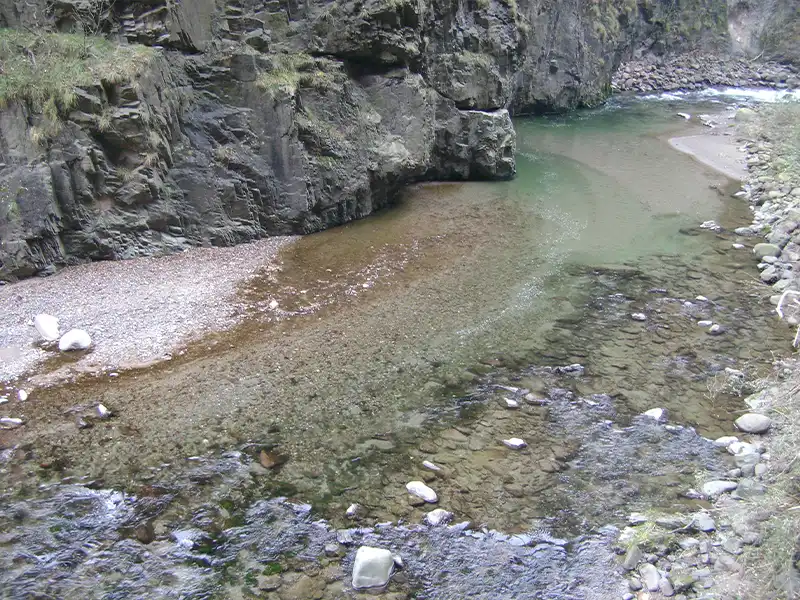
Steep rock walls create deeply scoured outside bends
The season runs from 1 May to 31 October. In October, fishing is permitted from the bank only, and spawning areas on gravel beds must be strictly avoided. Day-permit prices are fair, and young anglers can even get them at half price. Fishing is permitted with one fly only – dry fly, nymph or streamer – barbless, using a fly rod and without any additional weight on the leader. For all details and the current regulations, we also refer you here to the website of the managing association, the Angling Association of Bolzano.
What makes this stretch especially attractive is its easy access. It lies immediately north of Bolzano along the road into Val Sarentino. The upper half can be reached comfortably via a bridge behind Castel Roncolo and the road toward the Sill ice rink on the orographic left side, while the provincial road runs along the right side. All sections can therefore be reached quickly – ideal for a spontaneous afternoon session or as a fixed fishing point during a holiday in South Tyrol.
For visiting anglers, the Talvera offers an unusual but genuinely appealing setting: urban fly fishing with alpine character. If you like varied water, a solid fish population and straightforward access, this stretch is well worth a visit.
3.5. The Rio Ega – fly-fishing stretch 127b
The Rio Ega is a typical mountain stream, formed by the meeting of several Dolomite tributaries and flowing into the Isarco at Cardano. Below a diversion weir begins the fly-fishing stretch 127b, which runs downstream for just under five kilometres to the confluence. The section is divided into an approximately 4.1 kilometre gorge stretch and a flatter mouth section of around 700 metres near the village of Cardano. This is a water that comes into its own especially when the larger valley rivers – the Isarco, for example – are carrying high, coloured snowmelt. In the cool gorge of the Rio Ega, fishing remains pleasant even on hot summer days, and in the evening hours the dry-fly fishing can be outstanding.

A comparatively easy-access section of the Rio Ega
Hydrologically, this too is a residual-flow stretch below a dammed section. The minimum residual flow is 260 l/s and is increased further by several small tributaries. Despite the reduced water volume, the stream feels lively and well structured: alternating pools, tight runs, rocky sections and smaller pockets define the character of the water. The easiest access is from Cardano, where you can begin at the mouth and work your way upstream into the gorge. Alternatively, you can drive along the road into Val d’Ega: after the first tunnel, a few parking spots provide access to the water. Some of these entries are steep, however, and require sure footing.
The fish population in the gorge section is shaped by brown trout, marble trout and their hybrids. In the lower reach, fish also move in from the Isarco: alongside several trout species, you may encounter grayling, chub and, during the spawning period in June and July, large numbers of barbel – a remarkable natural spectacle. Despite the modest residual flow, good fish can be taken regularly in this part of the Rio Ega. Trout in the 40+ and 50+ cm class are no exception here.
Fishing on this stretch is permitted only with a fly rod. One dry fly, one nymph or one streamer is allowed – each barbless and with only a single point of contact. A second dropper fly is not permitted, nor is any additional weight on the leader. The season generally runs from 1 May to 30 September. For further details, the currently valid season dates and all other regulations, it is best to check the website of the Angling Association of Bolzano.

Inside the canyon of the Rio Ega – pure adventure
A few words on safety: the gorge stretch is visually impressive, but not always entirely harmless. On the steep, partly vertical walls, stones can come loose when conditions are unfavourable. In unstable weather or when thunderstorms are building, this stretch should therefore be avoided – the stream can rise very quickly and become dangerous. If you wait for good weather and stable conditions, however, you will experience the Rio Ega at its best – intense, striking and unmistakable.
Above the fly-fishing stretch lies section 127a. This is not a pure fly-only stretch: alongside the fly, artificial lures such as spinners and spoons are also permitted. Even so, it is worth a visit for fly fishers as well. Thanks to its good fish population – especially strong brown-trout numbers – this mountain stream offers engaging opportunities, particularly on warm summer afternoons and evenings.
The Rio Ega promises excellent fishing in a dramatic natural setting, but it also asks for a little fitness and a sensible amount of caution. Those who accept that will be rewarded with an exceptional fishing experience in a cool, rugged gorge – ideal for anyone looking for variety and authentic fishing away from the larger rivers.
3.6. The “Little” Isarco
Fly-fishing stretch no. 104 on the so-called Little Isarco begins at the Isarco bridge in Ponte Gardena and runs upstream to the Ponte Sant’Andrea in Chiusa. Over just under six kilometres, you follow the course of the Isarco northward up the valley, where the river is accompanied by the motorway, the Brennero railway and the state road – though in places these routes sit considerably higher above the water. Once you are down on the riverbank, you notice surprisingly little of these busy transport lines: the river lies quietly on the valley floor, and the surrounding landscape creates a remarkably sheltered atmosphere.

Well screened by bankside vegetation, the Little Isarco is a place where you can fully settle into the day
In Ponte Gardena and Chiusa, there are several access points to the river, and along the stretch there are repeated entry points and bridges that make getting in easier. On the orographic right side runs the Valle Isarco cycle path, sometimes directly beside the water, sometimes a little farther away. If you like, you can use it to skip individual sections neatly and return comfortably to the car later – useful when you want to keep the day flexible. The bank on this side is generally easier to walk as well, which is helpful when moving from one spot to the next. Overall, you should be reasonably sure-footed, able to climb the odd embankment, and equipped with sturdy wading boots with good grip as well as hip waders.
Hydrologically, this is a residual-flow stretch. Upstream lies a dammed section, where water is diverted into the power-plant canal. In the riverbed itself, a well-supplied residual flow of around 6.3 m³/s remains, fed further by several smaller tributaries. That is enough to keep the stretch lively and varied – with deep pools along the outside of bends reinforced with large boulders, long runs and distinct current seams. Still, it is important to remember that hydropeaking can occur without warning on this stretch when the sluices are operated. However beautiful and relaxing the fly fishing may be here, safety always comes first – keeping a watchful eye on the water level is essential.
The fish population in this section of the Isarco is varied and reflects the typical character of the mid-valley reaches. Marble trout, brown trout, hybrids of these two species and rainbow trout form the core population. Grayling are present in small numbers, though overall they play a more modest role. For many years, stocking here has been carried out exclusively with young marble trout, giving the water a largely natural, authentic character and offering anglers the chance to meet beautiful wild fish.
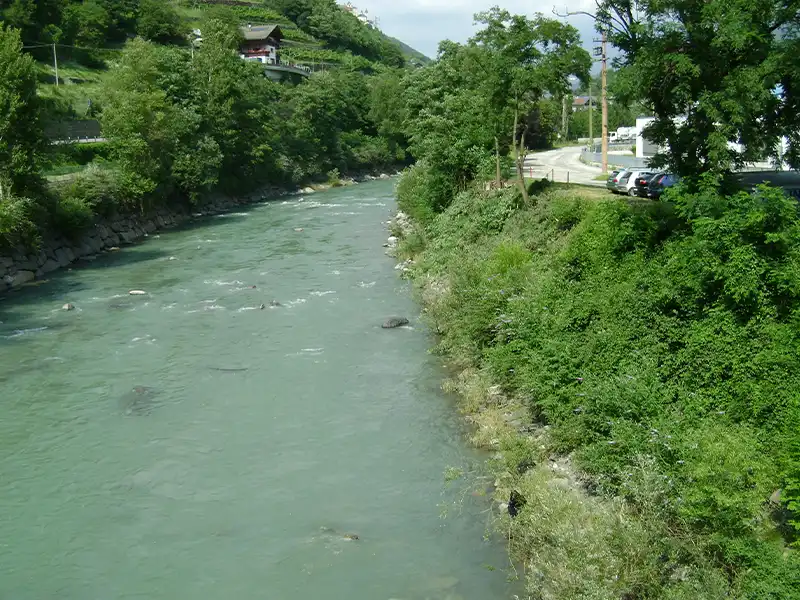
Prime conditions – when the water carries a touch of colour, the bigger fish often begin to move
The exact season dates and all other regulations can currently be found on the website of the managing Angling Association of Bolzano. In general, the season runs from 1 April to 31 October; from 30 September, fishing with streamers is prohibited, with only dry flies, wet flies and nymphs permitted thereafter. Fishing is allowed only with barbless flies, exclusively with fly rod and fly reel – additional weight on the leader is not permitted. A second nymph on a dropper, in a point-and-dropper setup, is allowed.
The best time for the Isarco is certainly spring, before snowmelt has fully taken hold. Then the many structures can be fished carefully and with precision. Autumn is also very worthwhile: once the nights turn cooler, the river clears quickly and offers ideal conditions for delicate fishing with dry fly and nymph. Even during snowmelt, when the flow is higher and slightly coloured, a visit can pay off – that is when streamers, sink tips or sinking polyleaders move into focus. If you are fishing specifically for larger marmorata, these conditions often produce the most exciting moments.
The Little Isarco is not an easy, automatic fishery. It is water that rewards active fly fishers who search for their fish and are willing to work for them. Take the time to read the structure and adapt to changing conditions, and this stretch will give you varied water, compelling fish and the unmistakable atmosphere of the valley.
3.7. The Rienza near Chienes
The Rienza rises at the foot of the world-famous Tre Cime di Lavaredo. On its way west, the main river of Val Pusteria gathers water from numerous tributaries and shapes the valley floor along its entire course. Today it is largely tamed, but wherever it is given room, it still forms broad gravel bars. Above Brunico, it uses its strength to cut through the rock, creating an impressive gorge section. Around Chienes, the Rienza shows itself from one of its most dynamic and interesting fishing perspectives. Its winding course creates varied structure, with shallow inside glides and deep runs along the outside bends. Below the village, the river is once again able to spread out more freely, forming lively water with gravel banks and a healthy mix of open and shaded banks.
The roughly 2.7-kilometre stretch managed by Pusterfly runs upstream to the bridge leading from the Val Pusteria state road into the village section of Casteldarne. The lower boundary is not immediately obvious at first glance, but clearly visible signs on both banks mark the fishing section precisely.

On the outside bend, the Rienza has carved out a deep run – that is where the nymph needs to be
In the lower third, the river has been extensively restored and widened in recent years. New structures were created, along with flooded gravel areas, shallow-water zones and deep pools. These measures have not only improved flood protection, but also created valuable habitat – for fish, insects and a wide range of other aquatic life. The effect is felt upstream as well, as the Rienza has regained more space and dynamism. After snowmelt or heavier rain, the changes become especially visible: the water keeps finding new paths, the river feels alive – and so does its fish population.
The stretch is very easy to reach and can be walked without difficulty along its full length. In the upper third, three bridges connect the village areas of Chienes and Casteldarne, making it simple to switch from one bank to the other. The Val Pusteria state road runs close to the river in places, and especially near the upper boundary by the industrial area there are several parking options. Along the Rienza, cycle paths and walking trails run on both banks, along with stretches of forest and consortium roads that make access to different parts of the water easier. It should be noted that the Val Pusteria railway line also follows the left bank of the Rienza in this area – particular care is required here.
The Chienes stretch is managed by the committed team behind Pusterfly, an initiative founded in 2023 and dedicated to the sustainable care of high-quality fly-fishing waters in Val Pusteria. The project grew out of the idea of preserving some of the valley’s finest waters specifically for fly fishing and managing them as naturally as possible. Cooperation with the local fishing wardens is close and pragmatic; stocking is deliberately kept to a minimum, with the focus instead on protecting and encouraging natural reproduction. In addition to this stretch, Pusterfly also manages the Rienza near Brunico. Together, these are two varied fly-fishing stretches marked by attractive structure, clear water and healthy wild-fish populations.
The Rienza near Chienes holds a solid and varied fish population. Here you will find not only lively brown trout, which thrive in the cool, oxygen-rich flows. The deep runs hold marble trout, which can grow to impressive sizes here. The chance of hooking a truly large marmorata is very real. Grayling also feel at home in this section of the Rienza and can be fished very well with the fly. The population is based largely on natural reproduction; additional stocking is barely required and is carried out only with fry and juvenile fish. The result is fish that are wild, strong and full of fight, making the fishing especially engaging and rewarding.

The Rienza near Chienes is a substantial river and very well suited to fly fishing
For fly fishers, the river offers a wide range of possibilities. In the shallower zones, the dry fly can be used to target rising fish, while in the deeper runs the nymph is usually the first choice. Medium-weight tungsten nymphs or modern Euro-nymphing techniques can be particularly effective for guiding the fly through the current with control. On duller days, or in the quieter deep pools, the streamer can come into its own – especially if you are deliberately hunting larger marmorata. The Rienza asks for attention and a feel for current and structure, but it gives back honest, varied fishing in an impressive setting.
The best time for fly fishing on the Rienza is spring before snowmelt and autumn, when the nights turn colder again and sediment input – especially from the Gadera – begins to drop. Then the Rienza shows its finest side: the water runs stable, and the fish are active. During this period, many areas can be fished precisely with nymph or dry fly, while the autumn colours of Val Pusteria add a distinctive atmosphere of their own.
This fishery shows how river restoration and sustainable fisheries management can work together in a meaningful way and help create resilient fish populations. For ambitious fly fishers, this section is a rewarding piece of water – versatile, alive and shaped by constant change. Those who take time to read the current, observe the structure and let the mood of the river settle in will spend many memorable hours here with a fly rod.
Further information about this and other fly-fishing stretches in Val Pusteria managed by Pusterfly can be found on the Pusterfly Facebook page.
3.8. Rio Selva dei Molini
The Valle dei Molini is the largest side valley of the Valli di Tures e Aurina and reaches about 18 kilometres into the mountains. The road follows the course of the stream, past Lago di Meggima and up to the Lago di Neves reservoir, before eventually coming to an end. The surroundings feel remote and largely natural – a welcome setting for fly fishers.
The section of the Rio Selva dei Molini described here is around 3.5 km long, running downstream from Lago di Meggima to the Mühlener Klamme. From a hydrological point of view, the water is a residual-flow stretch, but morphologically it remains a consistently natural mountain stream, with widths between roughly four and ten metres. Its structure is varied: deep pools, fast runs and quieter side water alternate throughout, creating diverse trout habitat.
The stream has the feel of classic alpine water: steeper sections with quick current, where pools and back eddies provide ideal holding lies, as well as flatter sections with slower flow, offering excellent conditions for fish of all age classes. At times the stream winds through denser woodland, then opens into brighter meadow sections – a constant shift of light, shade, current patterns and attractive structure that makes the fishing varied, engaging and rewarding. The Rio Selva dei Molini is home above all to brown trout, which can reach impressive sizes under natural conditions. Fish above the minimum size of 35 cm are no rarity. The stream therefore offers excellent conditions for near-natural fishing for wild, locally adapted trout.
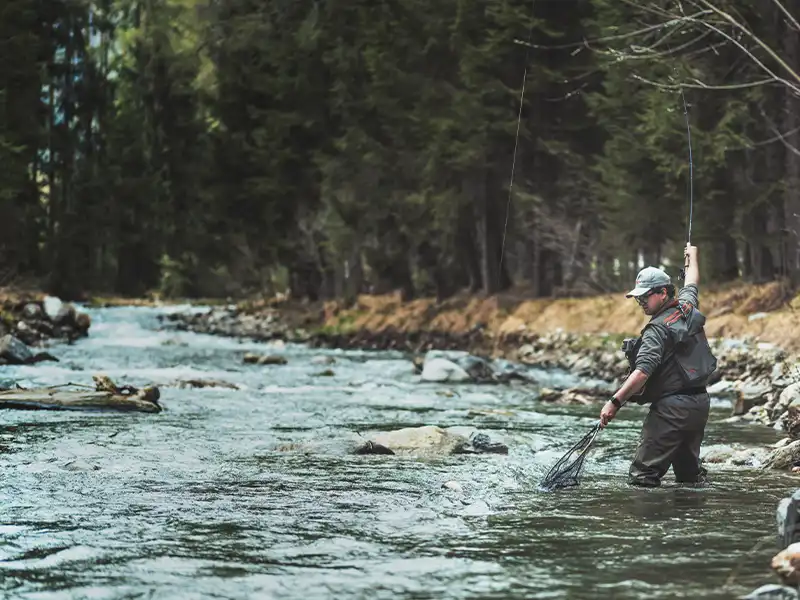
Successful fly fishing on the Rio Selva dei Molini
Thanks to the Lago di Neves reservoir and the smaller Lago di Meggima, the lower part of the Rio Selva dei Molini is largely unaffected by snowmelt and rain events. As a result, the stream offers very stable water conditions throughout the season and remains a worthwhile destination for fly fishers from spring into autumn. It is also a useful alternative when many other waters in the area are unfishable, or only partly fishable, because of current conditions. The stream has a special appeal during the summer months: temperatures are pleasant, wading is relaxed, and the dry fly can produce spectacular fishing. On hot days in particular, it pays to focus on the shaded sections, where fish remain active and conditions are excellent. You will find these in the lower part and just below Lago di Meggima, where the stream runs through wooded terrain. The middle section is a little more open, but is still largely lined on both banks by trees and shrubs, offering structure and cover – for fish and fly fishers alike.
The provincial road never runs far from the stream along its entire length, so virtually every part of the water can be reached easily. Access itself is also straightforward almost everywhere. Numerous bridges and nearby farm tracks make it simple to get down to the water. Please remember, however, that the adjacent areas are agricultural land. They are part of the valley’s cultivated landscape and should be treated with respect – so please do not simply cut across meadows, even if that sometimes looks like the shortest route to the stream.
Strict regulations apply on the Rio Selva dei Molini, and they benefit the fish population – and ultimately us anglers as well. Fishing is permitted only with a fly rod and barbless flies. Lago di Meggima divides the Rio Selva dei Molini into a lower section, described here, and an upper section that can also be fished with the fly – though not with the same day permit, but with a separate one. This upper section has excellent structure and is also very attractive from a fishing point of view; occasional grayling can be found there too. Day permits for both the lower and upper sections, as well as for Lago di Meggima itself, are available easily through the app. There you will also find all the necessary information on the applicable regulations.
3.9. The Aurino near Caminata
Valle Aurina is a side valley of Val Pusteria facing the main Alpine ridge and is rightly considered a natural jewel: framed by majestic three-thousand-metre peaks, threaded with clear mountain streams and marked by landscapes that still feel deeply original. Through this setting winds the Aurino – a river known well among fly fishers far beyond South Tyrol’s borders, especially for its grayling population.
The fly-fishing stretch near Caminata di Tures extends for around 2.5 kilometres and is regarded as one of the most interesting fisheries in the Valli di Tures e Aurina. The lower boundary lies at the confluence of the Rio Selva dei Molini, while the upper boundary is at the confluence of the Rio Riva in Campo Tures. Only fly fishers may pursue fish here; the zone is clearly signposted and designated “Fly Only”. When the name “Aurino” comes up among fly anglers, the conversation quickly turns to the river’s remarkable grayling stock.

Autumn grayling fishing on the Aurino – a wonderful time to be there
The Aurino near Caminata is already a substantial valley-floor river: long, largely lined with boulder reinforcement, with deeper runs along the outside bends and shallow glides tapering out on the inside. Solid casting technique is certainly an advantage here if you want to fish the water systematically and efficiently. Depending on the situation, a broad range of approaches comes into play – from delicate dry-fly presentations in quieter sections to deep nymphing when the large grayling and trout are holding near the bottom. If, on the other hand, you are specifically targeting big trout, then streamers combined with a sink tip or sinking polyleader are the way to go.
The fish population includes grayling in impressive densities, alongside brown trout and marmorata as well as rainbow trout. The grayling stocks are considered particularly strong, and among those who know the river, the Aurino is deservedly counted among the finest grayling rivers in the Alps – both in terms of fish numbers and size. The stretch is designated as a no-kill zone; fishing is permitted only with a fly rod and a maximum of two artificial barbless flies.
Access to this stretch is excellent: the provincial road follows the Aurino in this area on the orographic right side and remains within sight of the river. On the left side, a surfaced track runs downstream from Caminata, partly as a public road and partly as a cycle path. From Caminata up to the upper boundary in Campo Tures, a walking trail also follows the Aurino on the orographic right. This means almost every part of the river can be reached easily on foot, and you can move very flexibly between individual holding spots.
The fishing season on this section of the Aurino usually runs from late March to late November. Day permits for the Caminata fly-fishing stretch are available directly from Helmuth Rier – Tel. +39 348 260 7488.
The best conditions for trout fishing are usually found in spring through early to mid-May, before the snow begins to melt at higher elevations. If your main focus is the Aurino grayling, however, autumn is not to be missed. From September through the end of the season, the Aurino reveals its full potential: sight fishing with the dry fly to rising grayling, precise nymphing through the deeper runs – depending on water level and time of day. For fine grayling fishing, this river can still deliver truly memorable hours.
3.10. Rio Anterselva
Valle Anterselva in Val Pusteria is one of the most beautiful and unspoiled valleys in South Tyrol. Set away from the major transport routes, it stretches for 21 kilometres up to the Passo di Stalle, the pass crossing into East Tyrol. At 1,642 m above sea level lies Lago di Anterselva – a turquoise mountain lake at the head of the valley, framed by imposing peaks. This is also where the Rio Anterselva rises, a 24.6 kilometre mountain stream that drains the entire valley, remains almost entirely unmodified and flows into the Rienza near Valdaora. Thanks to its clear, cool water and its many tributaries, it is one of the most appealing mountain streams in South Tyrol for fly fishers.
Fishing district no. 158 extends for around 11 kilometres from the outflow of Lago di Anterselva to below the bridge near Hotel Bad Salomonsbrunn in Anterselva di Sotto. Along its entire length, the stream has exceptionally high water quality and an intact, self-reproducing fish population – a rare example of a mountain stream that has largely retained its original character.

Bankside vegetation creates excellent holding cover and calls for pinpoint casts
Immediately below the outflow of Lago di Anterselva, past the well-known Südtirol Arena biathlon centre, the stream shows itself in its most natural form: narrow, clear and full of life. Around 3–4 metres wide, it rushes through the landscape of the upper valley. This is primarily brook trout water, though brown trout and smaller marble trout are also present. In this roughly 2.5 kilometre section, the point is not trophy fishing, but fine, precise fishing in a remarkable mountain setting. The stretch ends at the intake of the Anterselva power plant, where a larger pool often still provides a few exciting casts.
The middle section between the water intake and the bridge on the main road is currently designated as a closed conservation area. A massive debris flow in 2005 severely affected this part of the stream, and since then it has been reserved for the recovery of the wild-fish population. Recent surveys show encouraging development – a good sign that this section may eventually return to its former quality.
From the bridge near Anterselva di Mezzo, the lower section begins and runs down to the wooden bridge near Hotel Bad Salomonsbrunn. Here, the Rio Anterselva shows its full range: fast, rushing water with deep pools alternates with quieter, slightly sandy stretches. At 5–7 metres wide, the stream offers everything you would expect from a typical mountain river – set against the open valley floor of Anterselva.
From a fishing perspective, this section is especially interesting. Alongside brown trout and char, it holds marmorata and hybrids, some of which reach surprising sizes. A 63 cm hybrid was landed here after a 20-minute fight – proof that the Rio Anterselva is home to more than small mountain trout. In the faster sections, larger fish hold behind big stones, while the quieter, restored reaches give dry-fly anglers fine opportunities for delicate presentations – often within sight of wary fish.

This spot on the Rio Anterselva all but demands a fish
The Rio Anterselva holds an old, healthy wild-fish population that has been preserved over decades. Alongside the genetically distinctive marmorata and their hybrids, the stream is home to brown trout, brook trout and grayling. To protect this population over the long term, a strict catch-and-release principle applies to salmonids throughout the entire district. All fish must be released immediately and with the greatest possible care.
Fishing is permitted exclusively with a fly rod. Dry flies, wet flies, nymphs and streamers are allowed; an additional artificial dropper may also be used, with a maximum of two flies in total, all of course barbless. Other baits or methods are not permitted.
Fishing on the Rio Anterselva is generally possible from 1 April to 30 September. The number of day permits is limited, and advance reservation at least two days ahead is required. Permits are available only from the responsible contacts of the Antholz fishing district.
All current information, reservation contacts and detailed regulations can be found on the official website of the Fly Fishing Club Antholz. Good to know: in addition to day permits, combined permits for lake and stream are also available.
4. On the water with a guide – why it is worth it
Are you fly fishing in South Tyrol for the first time, or looking to discover a new water? Then spending a day or two with an experienced fly-fishing guide can be enormously helpful. Even though this article gives you plenty of useful information and practical tips, it can never replace the experience of a local professional standing beside you on the water.
A guide knows not only the structure of the water, but also the current conditions: water level, insect activity, typical holding lies and the best techniques for approaching the fish successfully. On unfamiliar rivers or streams in particular, having someone with you who knows the local water intimately can make the difference between a chance fish and a genuinely good day.
There is also the practical side. A guide will often give you valuable hands-on advice – whether on casting, fly presentation or choosing the right pattern for the situation in front of you. You do not just discover a new fishery; you quietly improve your own fishing at the same time.
In South Tyrol especially, where the waters are highly varied and sometimes demanding, an experienced guide can help you find your bearings quickly and make the best use of your time. Instead of spending hours searching for suitable spots or trying to interpret local conditions on your own, you can focus fully on what you came to do: fish.
We can recommend several excellent fly-fishing guides who have known and worked with their waters since childhood. They will not only show you the best places to fish, but also give you a genuine feel for what makes South Tyrol’s rivers and streams so distinctive.
4.1. Arnold Gufler
Arnold Gufler is a true institution in the South Tyrolean fly-fishing scene. He is the only EFFA-certified guide and fly-casting instructor (European Fly Fishing Association) in all of South Tyrol – and brings with him an exceptional depth of experience and technical knowledge. Arnold has turned his passion into his profession and knows the rivers and streams of Val Passiria like few others. He also guides guests beyond Val Passiria.

Arnold Gufler
Alongside classic guided fishing, Arnold also offers fly-fishing and casting courses. That makes him an ideal choice if you want not only to discover new waters during your holiday, but also to work specifically on your technique. Whether it is dry-fly fishing, nymphing or focused casting instruction – with Arnold, you get individual feedback directly on the water.
His calm, grounded manner and deep understanding of South Tyrol’s waters make every day with him genuinely valuable – for beginners as well as more advanced fly fishers. You can get an interesting insight into his work in our interview “Dream Job: Fishing Guide”. Further information and Arnold’s contact details can be found on the website of the Arnold Gufler Fly Fishing School.
4.2. Robert Kofler
Robert Kofler is one of the pioneers of guided fly fishing in South Tyrol. For many years, he has shared his experience with guests mainly on his home river, the Passirio – a river he knows as well as anyone. Having grown up just a stone’s throw from the water, Robert has spent countless hours on this varied mountain river and knows every bend, every pool and every mood of the flow.

Robert Kofler
His long-standing experience reaches far beyond South Tyrol. In addition to his work as a guide, Robert also travels widely to fish internationally – in both freshwater and saltwater. That versatility still shapes the way he works today. Whether classic or modern nymphing, dry fly or streamer fishing, Robert knows exactly where the fish are likely to hold and which method has the best chance of success. He passes on that knowledge with patience, calm and a fine sense for the situation in front of him.
Over the years, Robert has built up a loyal group of returning guests who value both his technical skill and his down-to-earth, likeable manner. As a guide, he looks after his guests in German and Italian, and English is no obstacle for him either – ideal conditions for a relaxed day of fishing in one of South Tyrol’s most beautiful regions.
If you would like to get in touch with Robert or learn more about his guided fishing, the best way to reach him is at: passerguide@gmail.com or +39 348 564 3706.
4.3. Diego Riggi
Diego Riggi is most at home, from a fishing perspective, in Valle Isarco and Val Pusteria – regions that are among the most striking in South Tyrol not only for their landscapes, but also for the variety of fly-fishing waters they offer. As an experienced guide, he takes you to selected stretches in these valleys, from larger rivers to quiet mountain streams, and helps you understand the particular character of each fishery.
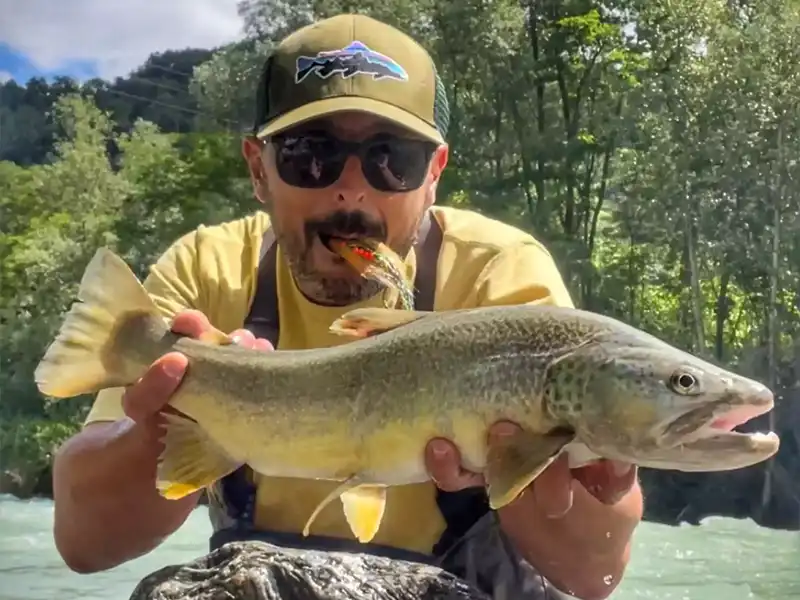
Diego Riggi
Diego’s guided trips are aimed at both beginners and experienced fly fishers. He places great value on shaping the day around the individual angler – your wishes, your level of experience and the current conditions on the water. Whether you want to take in the landscape of the Dolomites while fishing or simply spend memorable days on the river, Diego brings competence, calm and genuine passion to the experience.
Another clear advantage: in addition to Italian, Diego speaks fluent English, Spanish, French and Portuguese. Communication is easy and direct – a real benefit when you want to focus fully on the fishing.
You can find a more detailed insight into his work in our blog article about Diego Riggi. Further information about his guided trips and waters is available on his official website.
4.4. Leo von Guggenberg
Leo von Guggenberg belongs to the younger generation of passionate fly fishers in South Tyrol – and in his work as a guide, he combines international competition experience with a deep connection to his home waters. Raised in the South Tyrolean mountains, he has been standing on rivers and streams since early childhood – back then still accompanied by his grandfather, who introduced him to the fascination and quiet secrets of fly fishing. Today, Leo is well connected within the local fly-fishing scene and regularly competes internationally.
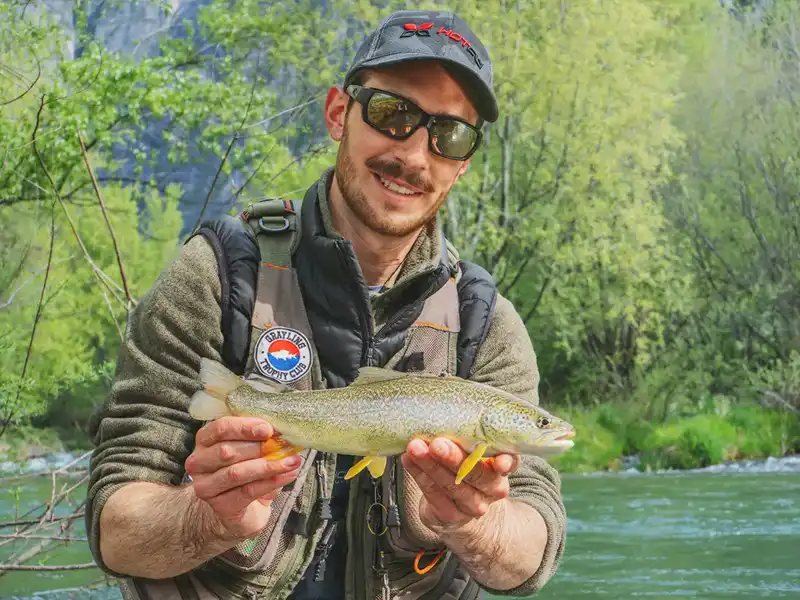
Leo von Guggenberg
As a guide, Leo takes anglers to selected waters in Valle Isarco, the Bolzano area, southern South Tyrol and neighbouring Trentino. His focus is on creating authentic fishing experiences – on waters he not only knows extremely well, but also manages and fishes with real commitment. He is happy to share insight into his approach as a competition angler, without the sporting aspect ever needing to dominate the day. From quiet mountain streams to powerful valley rivers, fishing with Leo gives you a particularly interesting perspective on the variety of alpine waters.
You can learn more about Leo, his philosophy and his work as a guide in our portrait on 1000flies.com. Current impressions, trips and fishing moments can also be found on his Instagram channel @fly_fishing_alps.
4.5. Oliver Schwienbacher
Oliver Schwienbacher grew up in Val d’Ultimo – in a landscape where water, mountains and nature have always set the rhythm of life. As a child, he spent countless hours on the Valsura and the surrounding streams, and since the age of four, fishing has never really let him go. What began as childhood fascination developed over the years into a deep connection with fly fishing and his home waters.
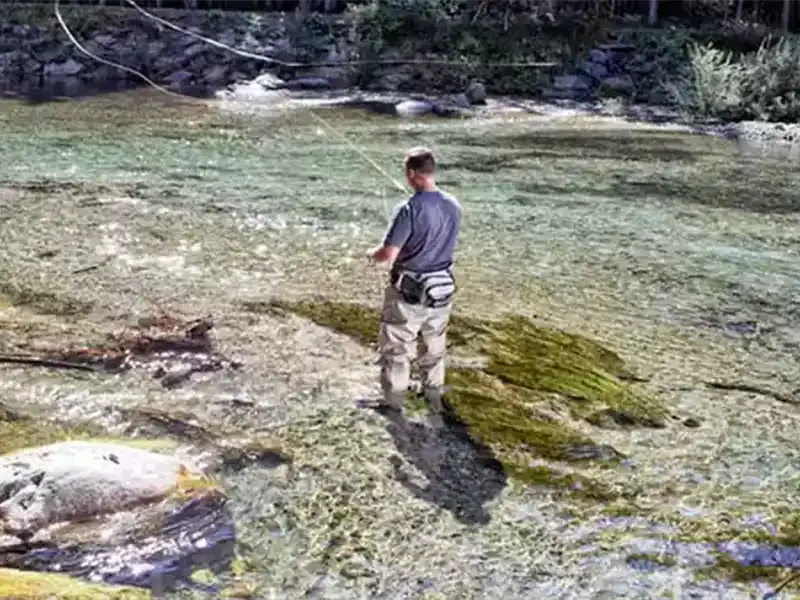
Oliver Schwienbacher
For more than two decades, Oliver has been fly fishing a wide range of waters at home and abroad. In 2011, he passed the exam to become an FFI instructor (Fly Fishers International) – a milestone that underlines both his technical skill and his experience in teaching the fundamentals of fly fishing. For many years, he worked intensively as a guide on a wide variety of waters, helping countless fly fishers discover the pleasure of casting, presentation and careful observation.
Today, guiding is no longer work for Oliver, but pure enjoyment. He spends most of his time on “his” waters in Val d’Ultimo – above all on the Valsura. Here, he knows every boulder, every undercut root and every holding lie. His favourite way to fish is with the dry fly, arguably the most exciting and immediate form of fly fishing, where every rise can be read on the surface and every moment on the water feels direct and alive.
As a trained instructor, Oliver offers casting courses alongside his guided days, giving anglers the chance to work specifically on their technique and correct casting faults that may have crept in over time. With his calm, attentive manner and fine eye for detail, he teaches fly fishing as he understands it himself – with passion, patience and a deep respect for nature.
For enquiries or further information, you can reach Oliver at schwienbacher.oliver@rolmail.net
5. What gear makes sense for fly fishing in South Tyrol?
Giving one universal gear recommendation for fly fishing in South Tyrol is not all that simple – and that is actually a good thing. Between powerful valley rivers, shaded mountain streams and still high-alpine lakes, there are not only many metres of elevation, but also very different demands on technique and equipment. The right setup always depends on the season, current conditions, the water you plan to fish and, of course, your personal preferences.
The good news: You do not need to buy special equipment for your South Tyrol trip that will sit unused in a corner once your holiday is over. With a classic 9-foot #5 fly rod, you are very well equipped for most of the waters presented here. Whether you are fishing delicate dries or classic nymphs, this combination covers a very wide range of situations.
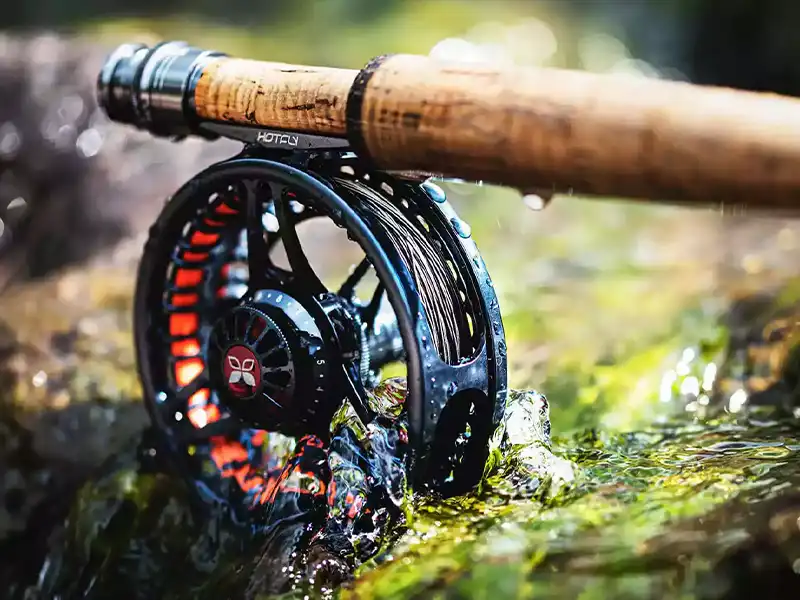
If you want to target larger fish with streamers in the bigger rivers, it is best to choose a slightly more powerful rod – perhaps one or two line classes heavier. Just as important as the rod is a suitably matched leader with higher breaking strength, strong enough not only for the size of fish you may encounter, but also for dealing with obstacles in the water.
The situation is very different on higher mountain streams. Here, shorter and lighter rods come into their own. An 8-foot #4 rod is ideal for classic dry-fly or nymph presentations. If you prefer the Italian Casting Style (ICS), crisp 7’6’’ rods make excellent companions for accurate casts on narrow, structure-rich streams.
At least as important as the rod is proper wading gear. This is not only about comfort, but very much about safety. Sturdy wading boots with grippy soles provide traction on slippery stones and reduce the risk of injury – a crucial factor, especially on unfamiliar waters. Whether you choose chest waders, hip waders or wading socks for small, shallow streams depends entirely on your preferences and the waters you plan to fish.


With the right wading gear, fly fishing is not only far more enjoyable – it is also much safer.
With this basic setup, you are well prepared to fish South Tyrol’s waters flexibly – whether you are facing a marmorata in a deep run or presenting to rising brown trout in a clear mountain stream.
6. Which flies work especially well in South Tyrol?
Choosing the right flies is a subject you could discuss for hours. In practice, though, it pays to focus less on one supposed “magic pattern” and more on matching your fly choice to the water, the season and the situation in front of you. With a few proven principles, you will be well prepared for most conditions and can look forward to excellent fishing.
6.1. Nymphs – a reliable choice throughout the season
For much of the season, the nymph is the most reliable way to fish successfully in South Tyrol. On unfamiliar waters in particular, it is often worth starting below the surface – where fish take much of their food. The decisive factor is not the most unusual pattern, but the right presentation: the nymph needs to reach the fish and drift cleanly with the current.

Classic Pheasant Tail nymph with an orange hotspot – a proven all-rounder
In many places, a dropper setup can be very effective, using – where permitted – a second, smaller nymph 30 to 50 cm above the point fly on a short dropper. The point nymph can be slightly heavier and tied on a larger hook size (#10–14), allowing it to get down quickly. The dropper (#14–18), by contrast, is usually lighter and moves very naturally in the current – often exactly the trigger that brings a fish to take.
Our experience shows that flies do not always need to be unusual or brightly coloured. Simple, classic nymphs in natural colours work extremely well in South Tyrol’s waters and produce reliable takes. A clean drift, the right depth and a feel for the current matter far more here than a particularly fancy pattern.

Peeping Caddis ... above all, your nymphs need to be presented close to the bottom
6.2. Dry flies – when the river comes alive on the surface
There are moments when there is no way around the dry fly: when the first rings appear on the surface during warm summer evenings, when trout become active toward dusk, when grayling rise in autumn, or when fish in clear mountain streams are ready to take. Then the surface becomes the stage – and a well-presented dry fly can make all the difference.
Things become especially interesting during intense hatches, when matching the natural insect as closely as possible matters – “match the hatch” is the key phrase here. Get the right pattern, and you often have a clear advantage, because when food is abundant, fish can become selective.


March Brown and Black Gnat deserve a place in your fly box, especially in spring
In the fast, turbulent sections of mountain streams, exact imitation is less important. What matters more is that the fly floats high and steadily and remains visible, so you can stay in control of the drift. Larger, buoyant flies, as well as imitations of land-based insects, known as terrestrials, are perfect for this kind of fishing.
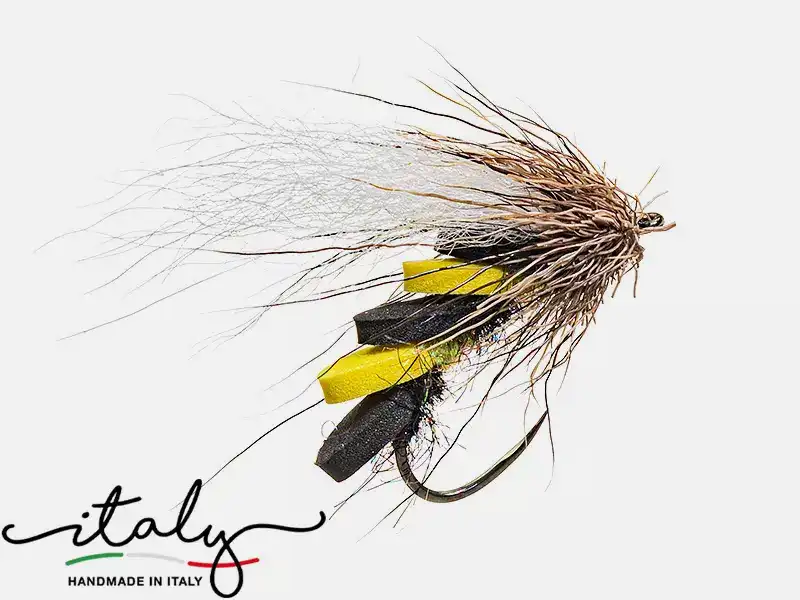
Grasshopper, caterpillar or, as here, a bumblebee imitation ... terrestrials are often the flies of choice on turbulent mountain streams in summer
The dry fly can also be highly effective outside hatch periods: search fly patterns – larger, fuller-bodied flies with excellent flotation – are often the best choice in summer for bringing fish to the surface even during seemingly quiet phases. Productive patterns have a natural silhouette that still stands out clearly against a low-contrast evening sky, with plenty of legs and antennae created by a slightly “buggy” tying style. These flies can be fished actively, skittered across the surface with small twitches and varied pauses, sometimes short, sometimes longer. A brief lift and gentle touchdown – imitating egg-laying caddis – can be especially tempting to fish. In shallower sections, where the water is less than roughly a metre deep, this approach can draw even large trout or grayling reliably up from the bottom to take your fly from the surface.

Floats beautifully even in turbulent current, remains highly visible and catches exceptionally well
6.3. Streamers – when bigger fish start to move
A classic streamer belongs in every fly box. On larger rivers, it can really come into its own after summer thunderstorms: once the water slowly begins to clear after a rise, visibility has returned to at least about the length of a boot, and the colour shifts from cappuccino brown toward latte macchiato, streamers often become the first choice. During the high water, many fish – including the bigger ones – move close to the bank edges, where the current is softer. That is exactly where it pays to fish carefully and deliberately. Present a streamer at the right depth with lively movement, and the takes can be spectacular.
And if you are specifically targeting large marmorata, this fly category is one you simply cannot ignore.


A classic Woolly Bugger and a minnow pattern ... yellow/gold is the insider tip for marmorata 🤫
Whether you are fishing nymphs, dry flies or streamers, what matters in the end is your feel for the water. Observe carefully, react flexibly and present your flies cleanly, and you will find exciting fly fishing not only on the stretches presented here, but also on many other waters throughout South Tyrol.
Tight lines and Petri Heil on the wonderfully beautiful waters of South Tyrol!

7. FAQ
All the essentials about fly fishing in South Tyrol, short and to the point:
South Tyrol offers an exceptional variety of waters within a relatively small area – from larger rivers and alpine streams to crystal-clear mountain lakes. Add to that a long fishing season, excellent water quality and healthy populations of brown trout, grayling and marble trout, and you quickly understand why the region is so popular among fly anglers. Thanks to the digital platform South Tyrol Fishing, planning your trip and buying day permits has also become easier than ever, making for a relaxed and flexible fishing holiday.
In South Tyrol, fishing is only allowed on waters where the respective fishing rights holder – usually a fishing club or private owner – permits it. Fortunately, many sections are open to guest anglers and offer day permits. Some of the best-known fly fishing waters include the Adige (Etsch), Passer, Rienza (Rienz), Isarco (Eisack) and numerous alpine streams.
The easiest option is the official South Tyrol Fishing App, where you can register, browse waters offering guest permits and buy your day ticket directly online. In some areas, traditional paper permits are still available, but the app has become the standard solution throughout much of the region.
Yes – and that is one of the app’s biggest advantages. You can buy a permit on the very same day or organise your fishing trip well in advance, avoiding the often time-consuming search for local ticket offices.
Besides a valid day permit, you also need the official Italian Type D fishing licence. This licence is valid throughout Italy, remains valid for ten years and is relatively straightforward to obtain. Many accommodations, tourist offices and local guides are happy to assist visiting anglers with the process.
Yes. As a visiting angler, you need two documents in order to fish public waters in South Tyrol legally: the Italian Type D fishing licence and a valid permit for the specific water you intend to fish.
The easiest way is through the South Tyrol Fishing App, the websites of local fishing clubs or experienced local guides. These sources provide all important information regarding permits, regulations, availability and current conditions.
Yes. Catch & release is permitted in South Tyrol and is even mandatory on many no-kill stretches. Protected species such as the marble trout must always be released immediately and carefully.
The most common target species are brown trout, rainbow trout, marble trout, grayling and char. The exact fish populations vary greatly depending on the type of water and the elevation.
Depending on the water, the season usually runs from February until October or November. Particularly good conditions are often found in spring, when the water is still clear before the snowmelt peaks, and again in autumn, when water levels stabilise and fish become highly active. High mountain streams often open a little later, usually in May or June.
Yes. Many waters are managed as fly-only stretches, where fishing is permitted exclusively with fly rods and artificial flies – usually barbless.
Regulations vary from one water to another, but common rules include fly-fishing-only restrictions, mandatory barbless hooks, limited harvest or complete no-kill regulations. Some stretches also restrict certain techniques, such as streamer fishing. For this reason, it is always important to check the current regulations of the specific water before fishing.
Absolutely. Thanks to the wide variety of waters, beginners will find many accessible and easy-to-fish stretches, while experienced anglers can explore more technically demanding rivers and streams. For newcomers especially, hiring a guide can make the learning curve much easier and more enjoyable.
For visiting anglers in particular, a guide can be extremely valuable. A local guide helps you find productive water quickly, understand local rules and improve both technique and presentation. This not only saves time but often increases your chances of success significantly.
For most waters, a classic 9 ft #5 fly rod, a small selection of proven fly patterns, breathable waders and reliable wading boots are perfectly sufficient. For larger rivers or streamer fishing, slightly heavier tackle is recommended.
As everywhere in fly fishing, presentation matters far more than the exact pattern. Proven classic flies will cover most situations extremely well. Nymphs are consistently productive throughout the season, especially on medium and larger rivers without visible surface activity. Dry flies are an excellent choice for mountain streams and alpine lakes and can also be highly effective on larger rivers during summer evenings. If your goal is specifically large marble trout, however, suitable streamer patterns are essential.

Questo potrebbe interessarti anche:

Dry-Fly Fishing at Lake Neves
Discover a hidden corner of the Alps where fly fishing comes with breathtaking views. With its crystal-clear water and unspoilt surroundings, Lake Neves is the perfect escape if you are looking for peace and a little adventure. Get ready for an authentic alpine experience that leaves you feeling refreshed.

FLY FISHING IN STILLWATER - everything you need to know
We would like to introduce you to the Froller cast, with which you can easily cast your fly 20 metres and more, even if you have little space behind you.
Dry-Fly Fishing at Lake Neves
Discover a hidden corner of the Alps where fly fishing comes with breathtaking views. With its crystal-clear water and unspoilt surroundings, Lake Neves is the perfect escape if you are looking for peace and a little adventure. Get ready for an authentic alpine experience that leaves you feeling refreshed.
FLY FISHING IN STILLWATER - everything you need to know
We would like to introduce you to the Froller cast, with which you can easily cast your fly 20 metres and more, even if you have little space behind you.

Summer Fishing Camps in Spain for Kids and Teens
Discover fishing camps in Spain for kids and teens in the Pyrenees. These international camps combine fishing, English and Spanish language learning, outdoor activities, and professional guidance. A unique experience to disconnect from screens, improve fishing skills, and enjoy active holidays in an outstanding natural environment.

Trout Fishing in Aragon
Discover Aragon, a still little-known destination for trout fishing in the Pyrenees. Between wild rivers, crystal-clear waters, and low fishing pressure, the region offers ideal conditions for anglers seeking tranquillity and wild fish. Thanks to careful management and well-preserved fishing stretches, you can enjoy an authentic experience in an exceptional natural setting.

The most important thing – always – is how we treat the fish
A fantastic day on the C&R stretch of the lower Noce near Mezzolombardo, together with Leo – a dedicated fishing guide, passionate competition angler, and skilled fly tier.

Dry fly fishing on the Travignolo
In this article, we’ll share our experience from a wonderful day of dry fly fishing on the Travignolo stream. You’ll also find all the information you need to relive our experience, along with helpful tips and advice.

Dry fly fishing at Lake Meggima
In this article, we’ll share our personal experience of dry fly fishing at Lake Meggima, along with useful advice on permits and regulations so you can recreate our experience at one of the most beautiful lakes in South Tyrol.

Moin Moin - this is where the magazine FliegenFischen is made
No trip to Hamburg would be complete without a visit to the FliegenFischen editorial office. Curious what editor-in-chief Michael Werner’s workspace looks like and what interesting things I learned about the magazine? You’ll find it all right here.

Fly fishing in Slovenia
In May 2024, due to the rain and the thaw in Trentino Alto Adige and the surrounding area, I decided to improvise a fishing trip by car to Austria and Slovenia, passing through some streams in South Tyrol and Veneto. In the first few days of the trip we managed to fish some small streams in Italy and Austria with moderate success, so we decided to continue with the search for new places to fish and get to know.

A DAY OF FISHING AT LAKE NEMBIA: A paradise for families and fishermen
Our adventure at Lake Nembia was an experience full of challenges and lessons. We discovered that, despite the abundant presence of trout, catching them can be anything but easy. The crystal-clear waters of the lake, combined with the selective nature of the fish, put us to the test, forcing us to constantly review our techniques and experiment with a wide range of flies and streamers.

The Ruetz & the Oberbergbach in the Stubaital (A) - first-class managed fly fishing beat
The Ruetz and the Oberbergbach have completely convinced us, with an exceptionally high density of game fish, sustainable management and fair day fishing licence prices.

AVISIO: fishing for big marble trout in Val di Fiemme
In this article, we take you on a discovery tour of the magnificent Avisio and give you all the information you need to experience wonderful fishing in the waters leased by the Associazione Pescatori Dilettanti Val di Fiemme.

GRAYLINGS IN THE GREAT NORTH
My holiday trips to the North Cape took me to the banks of the Hårkan River, a magnificent river populated by beautiful grayling. A wonderful experience in a natural and wild area like few others in the world. In telling my experience, I hope to leave you with some useful information in case you find yourself in this area.

ARGENTINIAN ADVENTURES - Dorados on sight with dry flies
An unforgettable fly-fishing adventure! Chasing golden Dorados in small mountain streams with big dry flies and sight fishing. Untouched and natural places with a jungle flora and fauna of which there are very few left in the world. Crystal clear waters and red stone rivers await us to test our fishing skills at their best, where one catch is worth the whole trip!

Fly Fishing in Austria - Trojeralmbach
I have not often had the opportunity to fish with dry fly in such a breathtaking natural environment. The Trojeralmbach is a jewel full of greedy wild char...

Fly Fishing in Austria - Schwarzach
The Schwarzach is undoubtedly an ideal stream for fly fishing, both for dry fly fishing and nymph fishing - but when is the best season for fly fishing? We will tell you in ...


